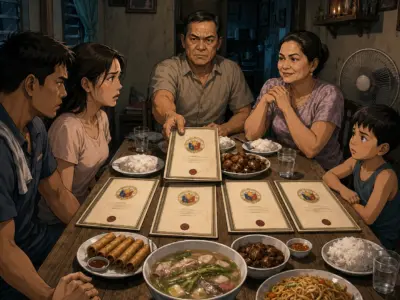
Sa harap ng barangay, mga kapitbahay, at dating asawang matagal nilang pinatahimik, isa-isang bumagsak ang pamilyang sanay gawing kulungan ang salitang respeto
Bahagi 4: Sa harap ng barangay, mga kapitbahay, at dating asawang matagal nilang pinatahimik, isa-isang bumagsak ang pamilyang sanay gawing kulungan ang salitang respeto
Si Nanay Cora ang unang nakabawi.
Tumakbo siya papunta sa pinto ng sala, pero hindi para buksan ang gate.
Para isara ang kurtina.
Parang kapag hindi niya nakita ang barangay officer sa labas, mawawala na rin ang reklamo.
Si Tatay Lito naman ay mabilis na tumayo. Dating kagawad siya, kaya kabisado niya ang tindig ng lalaking sanay igalang sa kanto.
—Ako ang haharap. Huwag kayong magsasalita.
Tumingin siya sa akin na para bang isa akong batang nahuling kumain ng kendi bago hapunan.
—Ikaw, Mariel, umakyat ka muna.
Hindi ako gumalaw.
—Hindi po.
Nagpanting ang tenga niya.
—Sabi ko umakyat ka.
—Narinig ko po.
Si Adrian ay nakatayo pa rin sa tabi ng mesa. Ang cellphone ko ay nasa kamay ko. Ang folder ay nasa sahig matapos niyang mabitawan. Ang mukha niya ay hindi galit ngayon.
Takot.
Hindi takot sa akin.
Takot sa eskandalo.
Iyon ang unang malinaw na nakita ko sa kanya. Hindi niya kinatatakutan ang maling ginagawa sa bahay. Kinakatakutan lang niyang may makaalam.
Muling kumatok sa gate.
—Tao po! Barangay assistance po ito. Buksan po natin nang maayos.
May boses ng babae sa labas, marahil barangay VAW desk officer. May isa pang boses ng lalaki, mas matanda, pormal ang tono.
Si Tatay Lito ay napilitan.
Binuksan niya ang pinto ng sala, saka ang gate. Mula sa puwesto ko, kita ko ang tatlong tao sa labas: isang barangay tanod, isang babaeng naka-ID lace, at isang kagawad na hindi ko kilala.
Sa likod nila, may dalawang kapitbahay na halatang nakikiusyoso sa tapat ng tindahan ng yelo.
Likas sa subdivision ang tsismis. Kapag may aso na tumahol nang malakas, may lima nang nakasilip. Kapag barangay officer ang kumatok, kalahati ng kalsada may alam na.
Pinilit ni Tatay Lito ngumiti.
—Ay, Kagawad Ramon. Pasensiya na. Pamilya lang ito. Walang malaking problema.
Sumilip si Nanay Cora sa likod niya at agad na naglagay ng panyo sa mata.
—Hindi na po namin alam ang gagawin sa manugang namin. Bagong kasal pa lang, pero gusto na kaming ipabarangay.
Galing niya.
Wala pang tanong, biktima na siya.
Ang babaeng officer ay tumingin sa akin.
—Kayo po ba si Mariel Santos?
Lumapit ako.
—Opo.
—Kayo po ang tumawag?
—Opo.
Humigpit ang mukha ni Adrian.
—Mariel, seryoso ka? Pinahiya mo talaga kami sa barangay?
Tumingin ako sa kanya.
—Hindi ko kayo pinahiya. Humingi ako ng tulong.
—Pareho lang iyon!
Doon nagsalita ang babaeng officer.
—Hindi po pareho iyon, sir.
Tahimik na bigla ang sala.
Pinapasok namin sila, kahit kitang-kita kong gusto ni Nanay Cora harangan ang pinto gamit ang buong katawan niya.
Umupo ang kagawad sa silyang malapit sa bintana. Ang babaeng officer ay naglabas ng notebook. Ang tanod ay nanatili sa may pinto.
Si Tatay Lito ay agad nagsimulang magpaliwanag.
—Sir, Ma’am, may konting misunderstanding lang po. Ang manugang namin, medyo sensitibo. Tinuruan lang ng asawa ko ng gawain sa bahay, minasama na.
Nanay Cora sniffed, then lowered her head.
—Gusto ko lang naman siyang maging bahagi ng pamilya. Ako pa ang lumalabas na masama.
The officer looked at me.
—Ma’am Mariel, ano po ang nangyari?
I placed the folder on the table.
—Pinapapirma po nila ako nito.
Binuksan ng officer ang folder. Una, mabagal lang ang pagbasa niya. Pagdating sa bahagi na bawal akong magsumbong sa barangay, huminto siya.
Tumingin siya kay Adrian.
—Sir, kayo po ang asawa?
—Opo, pero hindi ko po iyan—
Hindi niya natapos.
Itinaas ko ang isang kamay.
—Nabasa niya po iyan kagabi. Sinabi niyang formality lang.
Tumikhim si Adrian.
—Hindi ko ibig sabihin na—
—Sir, hayaan po natin matapos si Ma’am.
Bumigat ang hangin.
Nagpatuloy ako.
—Dalawang linggo pa lang po akong nakatira rito. Walang lock ang kuwarto naming mag-asawa. Sinasabi po nila na bawal ang saradong pinto dahil pamilya raw. Ilang beses pong pumapasok ang biyenan kong babae habang tulog kami.
Napasinghap ang babaeng officer.
Si Nanay Cora ay agad nagtaas ng boses.
—Para magdasal! Para alagaan ang anak ko!
—Dalawampu’t siyam na taon na po ang anak ninyo, Nay.
May isang kapitbahay sa labas na hindi napigilang mapasabi ng mahina:
—Ay, Diyos ko.
Nakarating iyon sa loob.
Namula si Nanay Cora.
—Wala kayong alam!
Itinaas ng officer ang kamay.
—Ma’am, isa-isa lang po.
Inilabas ko ang notebook ko.
—Nagsimula po ito noong ginising niya ako ng alas-sais ng umaga para turuan akong dapat maagang bumangon ang manugang. Sumunod po ako. Kinabukasan, ginising ko rin sila nang mas maaga para ipakita ang parehong pag-aalaga. Doon sila nagalit.
The kagawad frowned slightly, but not at me.
—May pumasok po kayo sa kuwarto nila?
—Opo. Bukas po ang pinto. Walang lock, ayon sa patakaran nila. Ganoon din po kasi ang ginagawa sa amin.
Si Tatay Lito ay pumalo sa armrest.
—Kita ninyo? Bastos!
Mabilis kong sinalo ang salita.
—Iyon nga po ang punto ko. Kapag ginawa ko sa kanila, bastos. Kapag ginawa nila sa akin, pagmamahal.
Walang nakasagot.
Pagkatapos, inilabas ko ang photocopy ng blotter ni Bea. Hindi ko iyon kinuha mula sa kanila nang palihim noong gabing iyon. Kinunan ko lang ng malinaw na litrato bago nila naitago ang pouch. Pagkatapos, pina-print ko sa computer shop sa labas habang bumili ako ng suka at toyo.
Inilapag ko ang papel.
Nanlaki ang mata ni Adrian.
—Saan mo nakuha iyan?
—Sa mismong bahay na ito.
—Sinabi ko nang huwag kang maghalungkat!
Doon siya nagkamali.
Narinig ng officer ang sigaw niya.
—Sir, kalmado po tayo.
Pero hindi na kalmado si Adrian.
—Hindi ninyo naiintindihan. Iyong dating asawa ko, sinira niya ang pamilyang ito. Ngayon, itong asawa ko naman, hinahalukay ang lumang issue para palabasing abusado kami.
Tumingin ang kagawad sa photocopy.
—Bea Santos. Ito po ba ang dating asawa ninyo?
Hindi sumagot si Adrian.
Ako ang sumagot.
—Opo. At nandito po siya.
Para akong naghulog ng bato sa gitna ng tahimik na balon.
Lahat sila napalingon sa pinto.
Doon pumasok si Bea.
Hindi siya mukhang kontrabida. Hindi siya mukhang babaeng “sumira ng pamilya.” Simple ang suot niya: puting blouse, maong, buhok na nakatali, maliit na bag sa balikat.
Pero ang tindig niya ay hindi na tindig ng babaeng tumakas.
Tindig iyon ng babaeng bumalik dahil may isa pang kailangang iligtas.
Si Nanay Cora ay napaatras.
—Anong ginagawa mo rito?
Hindi siya pinansin ni Bea. Tumingin siya sa akin, saka sa officer.
—Ako po si Bea Santos. Dating asawa ni Adrian. May dala po akong kopya ng dati kong blotter at mga message noon.
Adrian’s face turned gray.
—Bea, huwag mong gawin ito.
Tahimik na tumingin si Bea sa kanya.
—Noong ako ang nagmamakaawa na huwag ninyo akong gawin ito, ginawa ninyo pa rin.
Hindi ako nagsalita.
That moment belonged to her.
Umupo si Bea sa tabi ko. Naglabas siya ng brown envelope, mas makapal kaysa nakita ko sa ilalim ng unan.
Inside were photocopies of messages, photos of bruised wrists from being grabbed, screenshots of bank transfers, and a handwritten list of “house violations” with fines.
Fifty pesos for waking up late.
Two hundred pesos for locking the bedroom.
Five hundred pesos for refusing to hand over ATM.
One thousand pesos for “answering back to Mama.”
The officer’s expression changed.
No longer domestic misunderstanding.
Pattern.
Bea spoke clearly.
—Noong kasal pa kami ni Adrian, pinapasuweldo niya ako sa account ko. Pero tuwing payday, kukunin ni Nanay Cora ang ATM ko para raw i-budget. Kapag tumanggi ako, sasabihin nilang hindi ako marunong maging asawa. Kapag nag-lock ako ng kuwarto, sisigawan nila ako.
She looked at Adrian.
—At kapag umiyak ako, sasabihin mo, “Huwag mong palakihin. Matanda na sila.”
The exact same sentence.
I felt my throat tighten.
Nanay Cora suddenly cried louder.
—Sinungaling! Gumagawa ka na naman ng kuwento!
Bea did not raise her voice.
—Kung kuwento lang, bakit itinago ninyo ang blotter ko sa bodega?
The kagawad turned to Nanay Cora.
—Ma’am, nasa inyo po ang original copy?
Hindi siya makasagot.
Si Tatay Lito ang sumalo.
—Lumang papel lang iyan. Hindi na dapat binubuhay.
Bea leaned forward.
—Hindi ninyo ba dapat binubuhay, o hindi ninyo dapat inuulit?
That hit harder than any shout.
Adrian suddenly stood.
—Enough. This is my house. I will not allow my ex-wife to sit here and humiliate my parents.
I looked at him.
—This house is still under mortgage, right?
He froze.
Nanay Cora looked at me sharply.
—Anong kinalaman niyan?
I opened another envelope.
This time, mine.
—Kasi noong ikinasal tayo, Adrian, sinabi mong ikaw ang nagbabayad ng bahay na ito. Pero kahapon, tumawag ako sa bank officer na nag-confirm ng amortization schedule dahil pinapapirma mo ako sa household budget. Nalaman kong hindi lang ikaw ang nagbabayad.
His jaw clenched.
—That is private.
—Exactly.
I slid the bank transfer copies across the table.
—May malaking down payment galing kay Bea noong kasal pa kayo. Three hundred eighty thousand pesos. Nakalagay sa transfer note: “For family home.”
Bea looked down.
I already knew, but seeing her face made it heavier.
—Hindi ko na hinabol noon, she said quietly. Gusto ko lang makaalis.
The officer wrote quickly.
I continued.
—Pagkatapos nilang maghiwalay, ipinakita nila sa mga kamag-anak na si Bea ang walang utang na loob. Pero hindi nila sinabi na tumulong siya sa bahay, sa gamot ni Tatay, sa groceries, pati sa monthly amortization.
Tatay Lito rose so fast his chair scraped the floor.
—Lies!
The tanod stepped closer.
—Sir, upo po tayo.
But Tatay Lito was not used to being told to sit in his own living room.
—Huwag ninyo akong tuturuan dito!
The kagawad’s voice hardened.
—Sir, barangay assistance po ito. Kung ayaw ninyo makipag-usap nang maayos, puwede po nating ituloy ito sa presinto.
Those words worked.
Presinto.
Not because Tatay Lito respected the law more than control.
Because scandal had a different smell when police were involved.
He sat down.
Nanay Cora was now sobbing into her panyo.
—Ginagawa ninyo kaming kriminal. Magulang lang kami. Nagpalaki lang kami ng anak.
For the first time, I answered with no smile.
—Hindi po lahat ng nagpapalaki ng anak may karapatang sirain ang asawa ng anak nila.
Silence.
Even the electric fan seemed louder.
Adrian looked at me as if he had never seen me before.
Maybe he had not.
He had met the woman who smiled.
He had married the woman who nodded.
He had not expected the woman who kept receipts.
The barangay officer asked if I wanted to file an official complaint.
Nanay Cora immediately screamed.
—Complaint? Laban sa pamilya ng asawa mo? Wala ka talagang hiya!
I looked at her.
—Nay, two weeks pa lang ako rito. Pero kung hindi ako kikilos ngayon, two years later baka ako naman ang nasa ilalim ng unan ninyo bilang lumang papel.
Bea’s eyes reddened.
That was when Adrian finally softened his voice.
—Mariel, please. Let’s talk privately. Huwag dito. Huwag sa harap nila.
I almost laughed.
For two weeks, privacy was selfishness.
Now that he needed it, privacy became sacred.
—No. Dito tayo mag-usap.
He stepped closer.
—Asawa kita.
—Then act like a husband.
He flinched.
I took off my wedding ring.
Not dramatically. Not angrily.
Just slowly.
I placed it on top of the folder labeled “Patakaran ng Bahay.”
—Hindi ako pipirma sa house rules ninyo. Pero pipirma ako sa complaint.
Nanay Cora gasped as if I had stabbed her.
Adrian whispered:
—You would ruin this marriage over this?
I looked at the open door, at Bea sitting beside me, at the officer holding the pen, at the folder that reduced me to “ikalawang asawa.”
—Hindi ako ang sumira. Naabutan ko lang na sira na.
The barangay meeting lasted almost three hours.
By noon, the whole street knew something had happened. By afternoon, the prayer group knew. By evening, three aunties from the chapel had already sent Nanay Cora messages pretending to ask if she was okay, while clearly asking for details.
But the real consequences did not arrive in one dramatic thunderclap.
They came like unpaid bills.
First, the barangay issued a written record of the incident. The officer recommended further legal consultation because of coercive household rules, privacy violation, and financial control. I was advised not to stay in the house while the matter remained unresolved.
I had already packed one bag before calling them.
That was another thing they did not expect.
They thought I called the barangay in panic.
I called when I was ready to leave.
My cousin arrived with a ride before sunset. Bea stayed until I got out safely. She did not hug me at first. We were not friends yet. We were two women who had survived the same hallway.
At the gate, she finally said:
—Sorry hindi kita nahanap bago ka ikasal.
I shook my head.
—Hindi mo kasalanan.
She looked at the house.
—Akala ko noon, ako ang mahina.
—Hindi. Nauna ka lang mapagod.
Her eyes filled, but she smiled.
—Ikaw, huwag kang magtagal.
I looked back once.
Nanay Cora was at the window, still holding her panyo, but she was no longer crying. She was watching.
Counting.
Planning.
Good.
So was I.
The next week, Adrian called me thirty-seven times.
I answered none.
He sent messages that started with anger.
“Pinahiya mo ako.”
“Hindi mo naiintindihan ang pressure ko.”
“Kasalanan ni Bea ito.”
Then they became softer.
“Uwi ka na. Ayusin natin.”
“Pwede tayong lumipat ng apartment.”
“Mama promised she will change.”
Then smaller.
“Please.”
“Miss na kita.”
“I made a mistake.”
I read them all.
I replied only once.
—We will talk through counsel.
That sentence did what tears could not.
It scared him.
Because men like Adrian can ignore pain, but they respect paperwork when it threatens salary, reputation, and property.
I consulted a lawyer recommended by a women’s desk volunteer. Since our marriage was very new, the options were explained clearly: legal separation, annulment grounds if applicable, protection mechanisms if harassment continued, and civil claims tied to property or financial coercion if they tried dragging my money into their household.
I did not pretend the process was easy.
In the Philippines, ending a marriage is not like deleting a photo.
It is paperwork, waiting, fees, hearings, questions, and people telling you to forgive because “sayang naman.”
But I was not in a hurry to remarry.
I was in a hurry to be safe.
So I filed what I could file. I documented every message. I kept screenshots. I recorded dates. I did not answer calls without a witness. I informed my employer not to release any personal information if someone called pretending to be family.
Two days later, Nanay Cora tried exactly that.
She called my office and told the receptionist:
—Ako ang mother-in-law ni Mariel. Family emergency. Pakibigay ang schedule niya.
The receptionist, bless her, followed protocol.
No information.
Nanay Cora then sent me a voice message.
—Ang yabang mo na ngayon. Nakalimutan mong babae ka. Kahit saan ka pumunta, asawa ka pa rin ng anak ko.
I forwarded it to my lawyer.
No reply.
Forwarding became my favorite form of silence.
Meanwhile, Bea made a decision of her own.
For years, she had kept her evidence because she feared being called bitter. But after the barangay meeting, she requested certified copies of her old complaint and submitted a sworn statement supporting mine.
She also filed a small civil claim for the money she had contributed to the house, not because she expected to recover everything quickly, but because she wanted the lie to stop living rent-free.
When Adrian found out, he came to my cousin’s apartment.
He did not come alone.
He brought Nanay Cora.
That told me everything.
A man who truly wanted to save his marriage would not bring the person who helped burn it.
My cousin refused to open the gate.
So Adrian stood outside, under the afternoon heat, sweating through his office polo.
—Mariel! Lumabas ka! Ayusin natin ito!
I opened the window on the second floor.
Nanay Cora looked up and pointed at me.
—Bumaba ka rito! Huwag kang magtago!
I held my phone where they could see it.
—Recorded ito.
She lowered her hand immediately.
Adrian’s face twisted.
—Why are you doing this? Hindi naman kita sinaktan.
That sentence.
That familiar minimum requirement.
I answered calmly.
—Hindi medalya ang hindi pananakit.
He looked genuinely confused.
—What do you want from me?
—Accountability.
—Nag-sorry na ako.
—Hindi sa akin lang.
His jaw moved.
He knew.
—You want me to apologize to Bea?
—You should have done that years ago.
Nanay Cora laughed sharply.
—Kay Bea? Iyong babaeng sumira sa pamilya namin?
I looked at her.
—Nay, pamilya ba ang tawag ninyo sa bahay na kailangan may biktima para gumana?
She opened her mouth, but no words came out.
A neighbor across the street was already filming. Adrian saw it and stepped back.
Again: not shame for what happened.
Fear of being seen.
I closed the window.
That video reached their relatives before dinner.
By the next morning, the family group chat that once praised Nanay Cora as “ilaw ng tahanan” had become quiet. One aunt privately messaged me:
“Mariel, totoong pinapirma ka nila ng rules? Ginawa rin ba nila kay Bea?”
I did not send gossip.
I sent one page.
The page that said I was forbidden to complain to barangay.
After that, the silence changed flavor.
The relatives stopped asking me to forgive.
They started asking Adrian what was wrong with him.
At work, Adrian tried to keep everything hidden. But scandal travels fastest through people who claim they do not like drama.
One of his cousins worked in HR at a partner company. Someone saw the public argument video. Someone else connected it to Bea’s old story. Soon, Adrian’s manager called him in—not because the company wanted to manage his marriage, but because he had listed his parents as dependents for certain benefits while declaring that he had no household conflict or legal disputes affecting his housing loan documents.
Nothing illegal was instantly proven there.
But audits do not need instant guilt.
They need questions.
His pending promotion was paused.
His housing loan assistance review was delayed.
The overtime projects he relied on were reassigned while HR checked whether there were reputational and documentation concerns.
For the first time in years, Adrian’s salary was not a shield.
It became a leash.
Nanay Cora blamed me.
Of course she did.
She went to chapel and cried in front of the women’s group.
—Pinalaki ko ang anak ko nang maayos. Tapos dalawang babae ang sumira sa amin.
But this time, Bea was not alone.
And neither was I.
One of the older women, the quiet one who sold kakanin after Sunday service, reportedly said:
—Cora, kung dalawang babae ang parehong kuwento, baka hindi sila ang problema.
That sentence traveled through the barangay faster than any formal notice.
Tatay Lito stopped going to his usual coffee spot for a while.
Men like him can survive being disliked. They cannot survive being laughed at.
The final confrontation happened almost three months later, not in their living room, but in a mediation room with plastic chairs, a long table, and a wall fan that squeaked every seven seconds.
Present were Adrian, his parents, their chosen relative, my lawyer, Bea, Bea’s representative, and me.
Nanay Cora looked older that day.
Not humbled.
Just tired from losing control.
Adrian looked like he had not slept properly. The polished engineer image was gone. His collar was wrinkled. His eyes were red.
Before the discussion began, he asked if he could speak.
My lawyer nodded, with conditions.
—No threats. No personal attacks. Keep it relevant.
Adrian swallowed.
Then he looked at Bea.
For a long moment, he could not speak.
Bea did not help him.
Finally, he said:
—Bea, I’m sorry.
Nanay Cora made a small choking sound.
Adrian continued, voice cracking.
—Hindi kita pinakinggan. Pinili kong isipin na sobra ka lang magreact kasi mas madali iyon kaysa aminin na mali kami. Mali ako.
Bea’s face did not change.
—Okay.
That was all.
Not “I forgive you.”
Not “thank you.”
Just okay.
Sometimes that is the most dignity a person can give to someone who took too much.
Then Adrian looked at me.
—Mariel, I’m sorry. I should have protected you.
I answered:
—Yes. You should have.
He waited for more.
I gave none.
My lawyer placed the terms on the table.
I would not return to the house.
He would stop contacting me directly.
All communication would pass through counsel.
He would sign a written acknowledgment that the “house rules” were not voluntary and would not be used to claim I abandoned marital obligations.
He would cooperate with the separation process and not involve his parents in communication.
As for Bea, separate negotiations would begin regarding the money she contributed to the home. Not as charity. Not as “past is past.”
As debt.
Nanay Cora slammed her palm on the table.
—Hindi kami mayaman para bayaran lahat ng gustong kunin ng mga babaeng ito!
My lawyer looked at her calmly.
—Then you should not have taken from them.
That was the cleanest sentence in the room.
Tatay Lito tried to argue, but the mediator stopped him.
—Sir, hindi ito palengke. Huwag po tayong sumigaw.
His face darkened.
For a man who used to command barangay respect, being corrected in a small mediation room was its own punishment.
Eventually, they signed initial agreements.
Not because they suddenly became good.
Because the documents had trapped them in the one language they feared: consequences.
Over the next months, things unfolded slowly but firmly.
Adrian moved out of his parents’ house to a small rented unit near his office. He said it was to “clear his head,” but everyone knew the company housing review and family scandal had forced his hand.
Without his monthly full support, Nanay Cora and Tatay Lito had to reduce expenses. The large house they had used as a kingdom became a burden. They rented out the front room to a call center agent and stopped hosting relatives every weekend.
The same relatives who once praised their “close family values” now avoided borrowing money from them because nobody wanted to be pulled into the issue.
Bea recovered part of her contribution through a settlement. Not all. Life is rarely that clean.
But enough.
Enough to pay debts she had carried quietly.
Enough to move to a better apartment.
Enough to stop feeling like leaving that marriage meant losing everything.
She messaged me a photo one evening: a small dining table, two chairs, a vase of cheap yellow flowers.
Caption:
“First table na walang sumisigaw.”
I stared at that message for a long time.
Then I replied:
“Deserve mo iyan.”
As for me, I returned to work and rented a studio near my office. It was small. The sink leaked. The neighbor upstairs dragged chairs like a ghost at midnight, though of course there was no ghost, only bad flooring.
But my door had a lock.
A simple lock.
Silver. Ordinary. Beautiful.
The first night I slept there, I locked the door, placed my bag on the chair, and lay down without waiting for footsteps.
No one entered.
No one adjusted my blanket.
No one told me what time a good woman should wake up.
I woke at ten in the morning the next day and made instant coffee.
It tasted like freedom.
Six months later, the legal process was still moving. Slowly, yes. But moving.
Adrian still sent messages through proper channels asking for reconciliation. He claimed he had changed. He said he was in counseling. He said he had finally realized his mother’s love had become control and his obedience had become cowardice.
Maybe true.
Maybe late.
I did not build my peace around verifying his growth.
One afternoon, I received a package from him. My lawyer inspected it first before forwarding it.
Inside was the wedding album.
No note except one line:
“I’m sorry I made you another Bea.”
I closed the album without opening it.
Then I placed it in a drawer where documents go when they no longer have power.
A year after I left that house, Bea and I met for breakfast at a small carinderia near the market.
We ordered garlic rice, fried egg, longganisa, and coffee too sweet for any doctor’s approval.
She laughed when she saw the food.
—Almusal na naman.
I lifted my cup.
—At least ngayon, tayo ang pumili ng oras.
She smiled.
There was no dramatic revenge music. No mansion burning. No impossible miracle.
Just two women eating breakfast at nine-thirty in the morning because nobody had the right to drag them out of bed before sunrise to prove they were worthy.
My life did not become perfect.
But it became mine.
Nanay Cora and Tatay Lito still lived in the same subdivision, but their gate stayed closed more often now. The neighbors no longer called her the perfect mother. They called her “iyong biyenang may house rules,” which in a place like that was almost a sentence.
Adrian lost his promotion that year. Officially, it was due to “internal restructuring and pending review.” Unofficially, everyone knew the company had chosen the quieter candidate, the one without a family scandal wrapped around his name.
He kept his job, but not his shine.
For a man who had built his identity on being the competent son, that was punishment enough.
One Sunday morning, unknown number called me.
I answered because my lawyer’s office sometimes used landlines.
It was Nanay Cora.
Her voice was smaller.
—Mariel.
I stayed silent.
—May I talk to you?
—About what?
She breathed heavily.
—Adrian does not visit as much anymore.
I looked out my apartment window. Downstairs, a vendor was shouting taho. Somewhere, a child laughed.
—That is between you and your son.
Her voice sharpened, the old Cora trying to return.
—Kung hindi ka sana nagulo—
I ended the call.
No explanation.
No sermon.
No performance.
Some doors are not slammed.
They are simply locked.
That afternoon, I bought a small sign for my apartment door.
Not a religious verse.
Not a family motto.
Just a neat wooden plaque that said:
“Please knock.”
I hung it under the lock.
Then I made breakfast for dinner, because I could.
Garlic rice. Egg. Tuyo. Coffee.
I ate slowly, with my feet on the chair, hair messy, phone on silent.
At exactly nine in the evening, Bea sent a message.
“Next week, breakfast ulit?”
I replied:
“Oo. Pero hindi alas-sais.”
She sent laughing emojis.
I laughed too.
And for the first time in a long time, the sound did not feel like defiance.
It felt like home.