In a courtroom far from Manila, where the gray skies of The Hague hang low over a city synonymous with international justice, a British barrister rose and delivered a defense that was as methodical as it was defiant. The man he stood for was no ordinary accused. He was Rodrigo Duterte—the former president of the Philippines, a leader whose name has become inseparable from the country’s bloody war on drugs and the fierce global debate it ignited.
The setting was the International Criminal Court (ICC), where Duterte faces allegations of crimes against humanity linked to anti-drug operations conducted during his time as mayor of Davao City and later as president. The charges are grave. The stakes, historic. And the defense, led by British lawyer Nicholas Kaufman, has made clear that it intends to challenge not just the facts alleged by the prosecution—but the very architecture of the case itself.

A Defense Framed by Principle
Before diving into legal argument, Kaufman began with a carefully calibrated disclaimer. The defense, he said, does not mock the dead, nor dismiss the grief of families who believe they lost loved ones to extrajudicial killings. Any criticism, he stressed, would be aimed solely at the prosecution’s legal document—the formal “Document Containing the Charges”—and not at victims or their relatives.
It was a calculated move. In cases involving alleged crimes against humanity, the moral terrain can be as treacherous as the legal one. To appear callous is to lose the battle for public opinion before the legal contest even unfolds.
Kaufman’s central thesis was straightforward: the prosecution, he argued, cannot demonstrate “substantial grounds” to believe Duterte committed the crimes charged. And unless it can, he insisted, the former president should not remain detained for years awaiting trial.
The Speeches: Words as Evidence
Much of the prosecution’s case hinges on Duterte’s public speeches—fiery, unscripted addresses that often included violent rhetoric against criminals and drug dealers. Duterte was never known for polished statesmanship. His language was coarse, his metaphors blunt. He threatened. He cursed. He boasted.
But Kaufman seized on an apparent inconsistency.
While the prosecution has shown selected clips and transcripts that appear to suggest incitement or endorsement of killings, Kaufman argued that many of the same speeches also contain explicit calls for lawful self-defense. In some addresses, Duterte told police officers to arrest suspects if possible, and to shoot only when their own lives were in danger.
“Do not kill if you are not in danger of losing your life,” Duterte said in one speech cited by the defense.
Kaufman’s argument was not that Duterte was a model of rhetorical restraint. Rather, it was that the prosecution had cherry-picked inflammatory lines while ignoring exculpatory ones. Out of dozens of speeches, he said, only 20 were formally cited in the charging document—and half of those contain statements encouraging adherence to the law.
If rhetoric is to be the foundation of criminal intent, Kaufman suggested, then the full context must be examined—not just the most explosive excerpts.
The “Elastic Mouth” Theory
One prosecutor, Edward Jeremy, had suggested that Duterte’s speeches reflected a kind of “elastic mouth”—issuing lawful instructions on one side while signaling violent intent on the other.
Kaufman dismissed the idea as speculative and logically unstable. If Duterte’s words cannot be trusted at face value, he argued, then they cannot reliably serve as evidence of criminal intent either.
He described Duterte’s speaking style as rambling and improvisational—more akin, he quipped, to James Joyce’s “Finnegans Wake” than Abraham Lincoln’s Gettysburg Address. The implication was clear: these were not carefully coded instructions to a death squad, but political hyperbole delivered in a uniquely Filipino vernacular.
Widespread or Systematic?
Under ICC law, crimes against humanity must be part of a “widespread or systematic attack” directed against a civilian population. Kaufman challenged whether the prosecution had met this threshold.
Count One of the charges, he noted, concerns nine alleged murders in Davao City. Hardly “widespread,” he argued. References to mass graves and bodies in quarries, he claimed, have not been substantiated by concrete forensic findings.
As for broader national allegations, Kaufman criticized the prosecution’s reliance on maps dotted with colored markers, NGO reports, and statistical data. None, he said, directly link the 49 charged incidents to a broader criminal policy orchestrated by Duterte.
He cited ICC jurisprudence suggesting that media articles and advocacy reports are generally insufficient to establish the required standard of proof.
In his telling, what the prosecution presented as a sweeping campaign of systematic murder might instead be a series of unconnected incidents—tragic, perhaps, but not legally attributable to a centralized criminal plan.
Who Was the Target?
Perhaps the most complex argument concerned the identity of the alleged “civilian population” targeted by the supposed attack.
The prosecution has, at times, suggested that the attack was directed against the Filipino population at large—those perceived or alleged to be engaged in crime. Elsewhere, it has framed the target more narrowly as suspected drug dealers and criminals.
Kaufman argued that this shifting definition reveals conceptual weakness. If the entire Filipino population was targeted, he said, that suggestion is “bizarre” and politically implausible. If, instead, the target was a subgroup of suspected criminals, then that group lacks objectively identifiable characteristics distinguishing it from the general population.
In ICC jurisprudence, he noted, a civilian population must be identifiable by objective criteria—not by subjective perceptions of police officers or vigilantes. If the definition of “criminal” depends on the discretion of whoever pulls the trigger, the selection becomes random, undermining the legal requirement that the attack not be against randomly selected individuals.
It was a technical argument—but one with potentially profound consequences. If the prosecution cannot clearly define the targeted population, the legal scaffolding of crimes against humanity may falter.
The Missing “Smoking Gun”
Repeatedly, Kaufman returned to what he called the absence of a “smoking gun.”
Despite years of investigation, he said, not one witness has testified to receiving a direct order from Duterte to kill a specific individual among the 49 charged incidents.
The prosecution’s case, he argued, relies on inference: Duterte’s rhetoric, the existence of anti-drug operations, and the deaths that followed. But inference is not causation. To establish criminal responsibility—especially under theories such as indirect co-perpetration—the prosecution must show a causal nexus between Duterte’s actions and specific murders.
He mocked a prosecution slide depicting a pyramid with Duterte at the apex and alleged perpetrators below. The visual was compelling, he conceded. But what was missing, he argued, was the connecting line—the evidence that an order traveled from the top to the bottom.
Without that line, he said, the pyramid collapses.
Indirect Co-Perpetration and the “Common Plan”
The prosecution’s principal theory of liability is indirect co-perpetration: that Duterte and others shared a common criminal plan to “neutralize” alleged criminals through violent means.
Kaufman countered that the only common plan was a legitimate, democratically supported policy to combat crime and drugs—one that helped propel Duterte from mayor of Davao to Malacañang Palace.
He dismissed the notion of a secret agreement to murder as “preposterous” and unsupported by direct evidence. There is no record, he said, of co-perpetrators meeting to agree on such a scheme.
The word “neutralize,” frequently cited by prosecutors as a euphemism for kill, became a focal point. Kaufman argued that in police parlance, neutralization can mean incapacitation or arrest—not necessarily death. He pointed to official police circulars emphasizing respect for constitutional rights and lawful procedures.
If the prosecution wishes to prove that “neutralize” meant “murder,” he implied, it must do more than color the word red on a presentation slide.
The Broader Question
As the hearing adjourned for a brief recess, one reality remained: this case is about far more than a single defendant.
For supporters of Duterte, the proceedings represent political persecution and international overreach. For critics, they are a long-overdue reckoning for thousands of deaths attributed to a brutal drug war.
The ICC must now determine whether the evidence meets the threshold for confirmation of charges. It is not yet a trial. It is not yet a verdict. But it is a critical juncture.
In The Hague, law moves deliberately. Rhetoric, whether fiery or forensic, eventually yields to evidentiary standards and judicial reasoning.
Nicholas Kaufman’s performance signaled that the defense intends to fight on every doctrinal front: intent, causation, common plan, targeted population, and the interpretation of words spoken in anger or bravado.
Whether those arguments will persuade the judges of the International Criminal Court remains to be seen. But one thing is certain: the legal battle over Rodrigo Duterte’s legacy has entered a new and intensely consequential chapter—one that will test not only the evidence in a single case, but the reach and resilience of international criminal law itself.
News

Hiniling ng Biyenan Kong Ibigay Ko ang Lumang Warehouse Ko Bilang Dowry ng Anak Niya—Pero Nang Malaman Nilang ₱80 Milyon ang Compensation, Doon Lumabas ang Tunay na Mukha ng Pamilyang Pinakasalan Ko
“Anak, nabalitaan ko may binili kang lumang bodega sa may Bulacan ilang taon na ang nakaraan?” Biglang tumahimik ang hapag-kainan….

Bago Kami Pumirma sa Civil Registry, Inamin Kong Buntis Ako sa Ibang Lalaki—Pero Nang Dumating ang Babaeng Pinili Niya Noong Gabing Iniwan Niya Ako, Doon Ko Nalaman na Pareho Kaming Limang Linggo
Sa mismong umaga ng dapat sana’y kasal namin sa papel, iniabot ko kay Rafael Soriano ang ultrasound result ko. Tumingin…

NANG TUMIGIL AKONG MAGING ASAWANG NAGHAHABOL, SAKA NIYA NALAMAN NA ANG BABAENG INIWAN NIYA SA DILIM ANG SIYANG MAY HAWAK NG LAHAT NG KATOTOHANAN
Sa ikatlong taon mula nang makalabas ako sa pribadong psychiatric ward sa Tagaytay, sa wakas naging eksakto na akong asawa…

Bago Kami Magpakasal, Narinig Ko Sa Livestream Ng Isang Abogada Na Ang Nobyo Ko Ay Niloloko Ako—At Ang Kabit Niya Ay Ang Matalik Kong Kaibigan Na Tinulungan Ko Sa Lahat
Isang gabi bago kami magpa-rehistro ng kasal, nalaman kong peke pala ang appointment namin sa Civil Registry. Hindi mula sa…

Tatlong Taon Ko Silang Minake-up Nang Halos Palugi, Tapos Tinawag Nila Akong Manloloko—Pero Sa Araw Ng Cosplay Convention, Nalaman Nila Kung Sino Talaga Ang “Murang” Baguhan
Tatlong taon ko silang ginawang maganda sa harap ng camera. Tatlong taon akong nagpuyat, napaso sa glue gun, nagbayad mula…
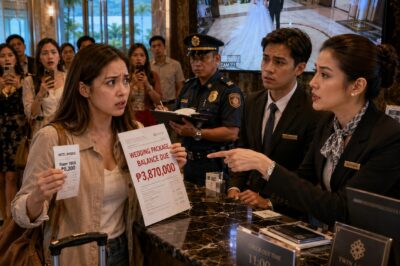
Nang Mag-check Out Ako sa Hotel, Pinabayaran sa Akin ang ₱3.8 Milyong Kasal ng Isang Lalaking Hindi Ko Kilala—Akala Nila Madali Akong Takutin, Hanggang Makita Ko ang Pangalan sa Kopya ng ID
Noong umagang mag-check out ako sa hotel sa Tagaytay, ang inaasahan ko lang bayaran ay ₱8,200 para sa tatlong gabing…
End of content
No more pages to load