The Morning My Retired Colonel Father-in-Law Left the Army Hospital, He Refused to Go Home—and Ordered Me to Drive Straight to His Lawyer Before His Sons Could Find Us
The Morning My Retired Colonel Father-in-Law Left the Army Hospital, He Refused to Go Home—and Ordered Me to Drive Straight to His Lawyer Before His Sons Could Find Us
Part 1 — Everyone Was Too Busy to Pick Up the Colonel—Until He Played Me a Recording That Changed Everything in the Truck
My father-in-law, Colonel Arthur Hale, had spent thirty-one years in the U.S. Army. At seventy-nine, a mild stroke finally put him in a hospital bed at Fort Cavazos.
The morning he was cleared to leave, every one of his three adult children suddenly had a reason they could not come.
Scott had a “client emergency.”
Nolan was “stuck in Dallas.”
My wife, Laura, said a migraine made it unsafe for her to drive.
I owned a commercial HVAC company outside San Angelo. I canceled two service calls and drove almost three hours east to get him.
Arthur was waiting in a wheelchair near the discharge desk, wearing an old field jacket with his colonel’s eagle pin tucked inside the pocket.
He looked smaller than I remembered, but his eyes were sharp.
The nurse helped him into my truck and handed me his medication instructions.
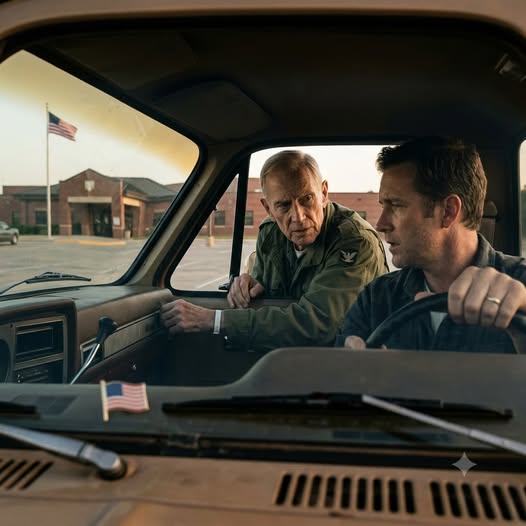
Arthur waited until we were beyond the main gate.
Then he locked all four doors.
Click.
“Evan,” he said, “do not take me home.”
I glanced at him.
“Where are we going?”
“Temple. Elena Ramirez’s office.”
“Your estate lawyer?”
“Yes.”
He pulled a black thumb drive from a pill bottle.
“Before we get there, you need to hear why.”
He connected it to a small recorder and pressed Play.
Scott’s voice came through first.
“If we get the capacity letter, the guardianship petition gets easier.”
Nolan answered.
“Then we move him into Cedar Ridge, list the ranch, and sign the warehouse deal.”
A third voice spoke.
Laura.
My wife.
“What if Dad refuses?”
Scott laughed.
“He won’t be the one deciding.”
My hands tightened around the wheel.
Arthur reached over.
“Keep driving.”
The recording continued.
They discussed his 312-acre ranch west of Lampasas, land his father had bought after Korea. A logistics developer had offered nearly $4.8 million for most of it because of a planned highway spur.
Scott wanted the proceeds invested through his firm.
Nolan, a real estate broker, wanted the commission.
Laura kept saying she only wanted their father “somewhere safe.”
Then Scott said, “Once the old man is out of that house, the hard part is over.”
Arthur stopped the audio.
“You recorded that?”
“The smart speaker in my study did. They forgot I use it to dictate letters.”
“They were talking like you had dementia.”
“I don’t.”
“I know.”
“My neurologist knows too.”
He stared through the windshield.
“They needed somebody else to believe it.”
At Elena Ramirez’s office, Elena herself opened the door.
“Colonel.”
“Counselor.”
No surprise.
She had been expecting him.
In the conference room, she placed three sealed folders on the table. The oldest was dated nine years earlier. Another was eighteen months old. The third had been prepared that morning.
I stared at Arthur.
“How long have you been preparing for this?”
“Nine years.”
“For your own children?”
“For the possibility that fear would turn into greed.”
Elena opened the oldest folder.
Inside were notes, bank records, dated letters, and four returned envelopes addressed to me.
I recognized Arthur’s handwriting.
“What are those?”
“Invitations,” he said. “Fishing. Veterans Day breakfast. My armor reunion. Your fiftieth birthday.”
“I never got them.”
“I know.”
Arthur looked at me.
“Laura told me you stopped wanting to spend time with me.”
“She told me you were tired and didn’t want company.”
His face tightened.
“Scott convinced her that if you and I spent too much time alone, I might put you in charge of the ranch.”
“That’s ridiculous.”
“I thought so too.”
Elena slid the newest folder toward him.
Arthur read every page, asked questions, corrected one parcel number, and signed.
I did not ask what he changed.
Before we left, he said, “By supper, they’re going to say you manipulated a stroke patient.”
“Why me?”
“Because you drove the truck.”
We reached the ranch after six.
Scott’s Escalade, Nolan’s BMW, and Laura’s SUV were already there.
Scott came down the porch steps.
“Where the hell have you been?”
Nolan followed.
“We called fifty times.”
Neither man opened Arthur’s door.
Neither asked how he felt.
Arthur climbed out on his own.
Scott’s voice softened instantly.
“Dad, we were worried sick.”
Arthur planted his cane on the gravel.
“No. You were worried I could still sign my own name.”
Nobody spoke.
Dinner was worse.
Scott kept asking what Arthur had signed.
Nolan called it “care planning.”
Laura never looked at me.
Around midnight, I woke and found her side of the bed empty.
She was in my truck with the dome light on.
The glove compartment hung open. Hospital papers covered the passenger seat.
“What are you looking for?”
She jumped.
Then her face hardened.
“Ramirez’s receipt.”
“You knew where we went.”
“Scott figured it out.”
“You’re searching my truck for your brother?”
“I need to know what Dad did.”
“You could ask him.”
“He won’t tell me.”
“Maybe there’s a reason.”
She walked toward the house.
Her phone was still on the passenger seat.
The screen lit up.
A family group chat was open.
Scott had written:
GET THE CAPACITY PETITION FILED BEFORE RAMIREZ RECORDS ANYTHING ELSE.
Nolan replied:
IF EVAN IS A WITNESS, WE MAKE EVAN THE PROBLEM.
Then I saw Laura’s message.
I’LL HANDLE MY HUSBAND.
Thirty years of marriage, and in four words, I finally understood why everyone had been “too busy” to pick up her father.
Part 2 — By Sunset, My Wife Was Searching My Truck, and Her Brothers Were Telling Everyone I Manipulated a Sick Veteran for His Estate
By Monday morning, Scott had already started telling people that I had taken a confused old man straight from a military hospital to an estate lawyer before his own children could see him.
By Wednesday, the story had changed.
Now I had supposedly pressured Arthur to “cut out his family.”
By Friday, two customers canceled maintenance contracts with my company. One had known me for twelve years.
“I don’t want to get dragged into a family lawsuit,” he said.
I had not inherited a dollar.
I did not even know what Arthur had signed.
But facts were losing to repetition.
Laura moved into the guest room.
For three days, she spoke to me only about groceries, mail, and whether I had given Arthur his evening medication.
Then Elena Ramirez called.
“Come to my office alone.”
A thick binder was waiting when I arrived.
Inside were emails Nolan had exchanged with a commercial developer four months before Arthur’s stroke. There were draft parcel maps, projected commissions, a proposed closing schedule, and a document titled TEMPORARY GUARDIANSHIP STRATEGY.
I read that title twice.
“They were preparing this before he got sick.”
Elena nodded.
“Long before.”
One email from Scott said they needed to establish “a documented pattern of confusion.”
Another suggested moving Arthur’s checkbook, changing passwords, and having relatives keep written notes anytime he repeated a question.
“He’s seventy-nine. Everyone repeats questions.”
“That was the point.”
Then Elena showed me something worse.
A neurologist had evaluated Arthur two days before discharge.
Alert. Oriented. Understands assets. Understands consequences. Demonstrates decision-making capacity.
Scott had already received a copy.
He had still told relatives that Arthur could no longer understand legal documents.
When I returned to the ranch that evening, Arthur was sitting on the porch in an Army sweatshirt, a blanket over his knees.
He looked exhausted.
“I’m sorry this landed on you,” he said.
“It didn’t land on me. They aimed it.”
That made him smile once.
Then he grew serious.
“There’s something else you need to remember.”
He reminded me of a night eleven years earlier when Scott’s government subcontracting company was close to collapse after losing a major bid.
Arthur had needed $84,000 quickly to keep Scott from defaulting on payroll and a bank note.
I had loaned Arthur the money from a retirement account and a home-equity line.
Nobody knew where it came from.
Not Scott.
Not Nolan.
Not Laura.
Arthur repaid every cent within two years.
“You told me never to mention it.”
“And you never did.”
He reached beside his chair and handed me a sealed tan envelope with my name across it.
“Do not open this unless they force you to defend your character.”
“What’s in it?”
“Proof of what you did when nobody was watching.”
I stared at the envelope.
“I don’t want anything from you.”
“I know. That’s why this matters.”
Six weeks later, Arthur suffered another stroke.
This one was massive.
He died before sunrise at the VA hospital in Temple.
At his funeral, Scott stood beside the flag-draped casket and told everyone his father had been “the moral center of our family.”
Nolan cried during Taps.
Laura held my hand for the first time in weeks.
For one moment, I thought grief might end the war.
It did not.
Nineteen days later, Scott and Nolan filed a challenge against Arthur’s trust.
Their petition claimed undue influence, diminished capacity, and intentional isolation from his children.
My name appeared on twelve pages.
Then I reached the final exhibit.
It was a sworn affidavit from Laura.
My wife.
She stated that after Arthur’s stroke, I had “positioned myself as the primary gatekeeper,” discouraged family contact, and transported him to a lawyer without informing her.
I read the paragraph again.
Then I looked at the signature.
Laura Hale Cole.
Signed under penalty of perjury.
That evening, I placed the affidavit on the kitchen table.
Laura came in, saw it, and stopped cold.
“You signed this?”
Her eyes filled.
“Evan, I can explain.”
“Then explain why my own wife just gave your brothers the document they needed to call me a predator in court.”
Part 3 — At the Hearing, the Sealed Envelope Exposed the Real Betrayal—and the Family Finally Learned Who Had Been Protecting Them All Along
Laura sat down without touching the affidavit.
“Scott wrote most of it,” she said. “He told me it was only to preserve our right to question Dad’s trust.”
“You still signed it.”
“I know.”
“You swore I isolated him.”
“I was angry and scared. I let my brothers convince me that if Dad trusted you, it meant he trusted us less.”
I slid the paper toward her.
“That sentence just cost you my trust.”
For once, she did not defend herself.
The hearing was set for six weeks later in Lampasas County probate court.
Before it began, Laura did something her brothers never expected.
She hired her own attorney and filed a corrected affidavit.
She admitted the family group chat existed, admitted she had searched my truck, admitted Arthur had never been prevented from speaking to his children, and admitted Scott had discussed guardianship before the stroke.
Scott stopped returning her calls.
Nolan called her a traitor.
On the morning of the hearing, Elena placed Arthur’s sealed envelope in front of me.
“You may need this today.”
Scott’s attorney described me as a financially stressed son-in-law who had inserted himself between a vulnerable veteran and his natural heirs.
Then Elena stood.
She played Arthur’s recording.
The courtroom heard Scott say, “If we get the capacity letter, the guardianship petition gets easier.”
It heard Nolan discuss commissions.
Then Elena introduced the emails, parcel maps, proposed warehouse sale, and guardianship strategy drafted months before Arthur became ill.
Finally, she called Arthur’s neurologist.
“Did Colonel Hale understand the documents he signed?”
“Yes.”
“Was he confused about his property?”
“No.”
“Was he incapable of making legal decisions?”
“No.”
Scott’s attorney changed direction.
He argued that even a competent person could be manipulated by someone he trusted.
Elena looked at me.
“Mr. Cole, open the envelope.”
My hands shook.
Inside were copies of the $84,000 transfer I had made eleven years earlier, Arthur’s repayment records, and a notarized memorandum written seven years before his stroke.
Arthur had once offered me a ten-percent interest in the ranch as thanks for helping save Scott’s company.
I had refused it.
My written response was attached.
I WANT NOTHING THAT SHOULD ONE DAY BELONG TO YOUR CHILDREN. PAY ME BACK WHEN YOU CAN. THAT IS ENOUGH.
Scott went pale.
He had spent weeks calling me a fortune hunter.
Now the court knew I had once been offered part of the same ranch and turned it down.
But Arthur had left one more surprise.
His final trust did not give me the ranch.
It did not give Laura, Scott, or Nolan the ranch either.
The 312 acres had been transferred into a charitable land trust to become Hale Station, a nonprofit retreat and transition center for veterans and military families facing disability, unemployment, or the move back into civilian life.
An independent trust company controlled the money.
I was named only to an unpaid advisory board.
Each of Arthur’s three children received a fixed $40,000 bequest and personal family items.
The multimillion-dollar sale they had planned was dead.
The judge upheld the trust and rejected the claim that I had coerced Arthur, citing the medical evaluation, attorney notes, recordings, and the challengers’ own emails.
Faced with deeper discovery into their financial interests, Scott and Nolan withdrew their remaining claims. Under the court-approved settlement, they paid a substantial portion of the trust’s legal expenses personally.
Nolan lost the developer deal he expected to control.
Scott’s investment firm placed him on leave after clients learned he had planned to steer estate proceeds into accounts he managed.
No one went to prison.
They lost the thing they had tried to seize before their father was dead: control.
Laura and I did not repair thirty years of marriage in one courtroom.
She apologized without excuses, entered counseling with me, cut off financial dealings with her brothers, and spent months helping catalog Arthur’s military papers for the veterans center.
A year later, we stood outside the restored red barn as the first six veterans arrived for an employment-transition program.
Arthur’s colonel insignia was mounted inside the entrance.
Below it was a brass plate.
SERVICE IS WHAT YOU DO WHEN NO ONE IS KEEPING SCORE.
Laura slipped her hand into mine.
This time, I let her keep it.
The ranch was still standing.
Arthur’s name was still on the gate.
And the people who had treated his life like a closing date never sold a single acre.