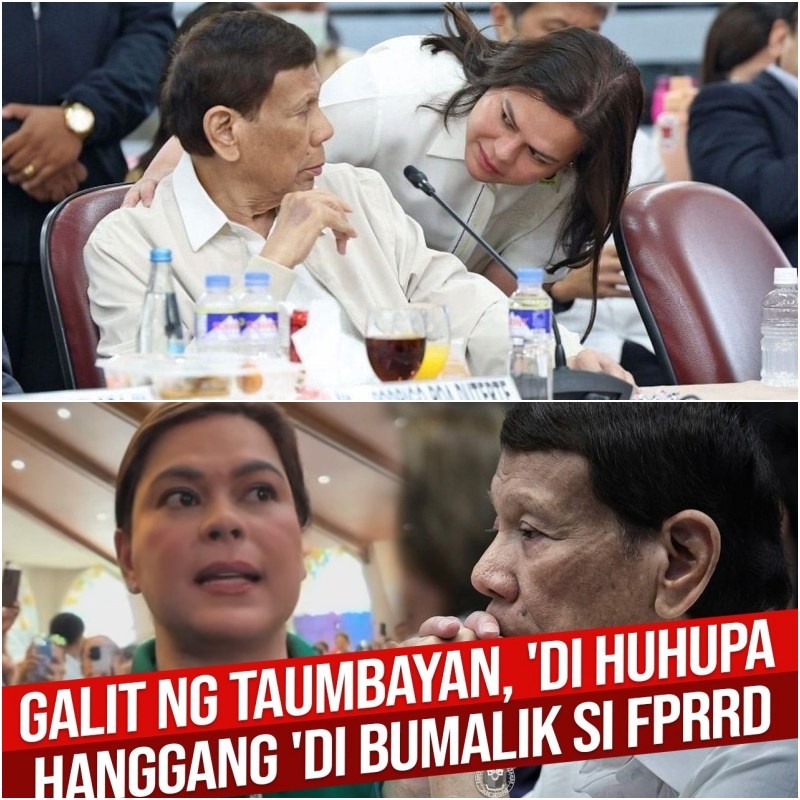
In the charged and often emotional landscape of Philippine politics, certain moments transcend ordinary political debate and become symbols of deeper national tensions. One such moment came as Sara Duterte, the country’s vice president, addressed reporters and supporters regarding the ongoing legal situation involving her father, former president Rodrigo Duterte.
Speaking with visible seriousness, the vice president delivered a message that resonated strongly among supporters who have been following the developments closely.
According to her, the anger felt by many Filipinos—especially in Duterte’s hometown of Davao—has not subsided even after a year.
“The anger of the people will not fade until he returns,” she declared.
Her words reflected the intensity of sentiment surrounding the controversial transfer of the former president to face proceedings at the International Criminal Court, a move that continues to divide opinion across the Philippines.
For supporters, the issue represents what they see as an injustice done to a former national leader. For critics, it is part of a broader global effort to examine allegations tied to Duterte’s controversial anti-drug campaign during his presidency.
Between these opposing views lies a nation still grappling with the legacy of one of its most polarizing leaders.
A Year After the Controversy Began
Nearly a year has passed since Duterte’s legal ordeal began attracting international attention. Yet the issue remains as emotionally charged as it was when the first headlines appeared.
Supporters argue that the decision to allow a Filipino citizen—particularly a former head of state—to face legal proceedings in an international court raises serious questions about sovereignty and national dignity.
Vice President Sara Duterte echoed that sentiment during her remarks.
She described the situation as something many Filipinos find difficult to accept, regardless of political affiliation.
For her supporters, the issue goes beyond politics.
It is about national pride, legal fairness, and the treatment of a leader they believe served the country with determination.
Anger in Davao
During the interview, the vice president mentioned the strong reactions she encountered while visiting communities in Davao, the city that served as the political stronghold of her father for decades.
Davao has long been associated with Rodrigo Duterte’s political identity. It was there that he served multiple terms as mayor before rising to the presidency in 2016.
For many residents of the city, Duterte is more than a former president—he is a figure who shaped local governance and built a loyal following over generations.
Sara Duterte said she sensed deep frustration among residents who feel that the former president has been treated unfairly.
She emphasized that the anger she observed was not limited to one region or political group.
According to her, Filipinos from different parts of the country share similar sentiments.
The Legal Debate
At the center of the controversy is the jurisdiction of the International Criminal Court over alleged crimes linked to Duterte’s anti-drug campaign.
The campaign, which aimed to eliminate illegal drug networks in the Philippines, became one of the defining policies of Duterte’s presidency.
Supporters credit the campaign with reducing crime and restoring public order.
Critics argue that it resulted in widespread human rights violations.
Because of these concerns, international organizations—including the ICC—began examining whether crimes against humanity may have occurred.
This legal examination eventually led to proceedings that continue to generate intense debate within the Philippines.
Efforts for Interim Release
Vice President Sara Duterte also addressed the possibility of seeking interim release for her father.
According to her, the legal team representing the former president continues to explore all available legal options.
She explained that whenever there is an opportunity to apply for interim release, Duterte’s lawyers will pursue it—even if the chances of approval appear uncertain.
For supporters, these legal efforts represent hope.
For critics, they are part of a legal process that must proceed according to international law.
Either way, the strategy reflects a determination to challenge the proceedings through every legal avenue available.
The Middle East Crisis and OFW Safety
During the same press interaction, Vice President Duterte was also asked about another pressing issue: the safety of Overseas Filipino Workers in the Middle East.
Millions of Filipinos work abroad, and many are employed in countries that sometimes experience political instability or conflict.
Recent tensions in parts of the Middle East have raised concerns about the well-being of these workers.
When asked whether the current administration’s preparations were sufficient, Duterte expressed skepticism.
She suggested that more proactive planning should have been undertaken earlier to ensure the protection of Filipino workers in the region.
Her remarks highlighted an ongoing debate about how governments should respond to international crises affecting migrant workers.
Criticism of Government Preparedness
Vice President Duterte did not limit her criticism to the Middle East issue.
She also raised concerns about domestic governance, particularly allegations of corruption tied to infrastructure spending.
Specifically, she referenced controversies involving flood control projects—an issue that has drawn attention in recent years as the Philippines continues to face destructive typhoons and flooding.
According to her remarks, billions of pesos have been allocated for flood control programs over several years.
Yet she questioned whether those funds have produced the results that communities desperately need.
She also criticized what she described as a lack of accountability among officials linked to these projects.
The “18 Marines” Investigation
Another topic discussed during the interview was a Senate investigation involving a group of Marines whose allegations have attracted political attention.
While details of the case remain under investigation, the controversy has sparked debate about transparency within government institutions.
Vice President Duterte expressed frustration that while certain investigations move forward quickly, others—particularly those involving alleged corruption—appear to progress more slowly.
Her comments suggested a broader concern about consistency in how political controversies are handled.
A Message of Gratitude to Supporters
Despite the criticism and frustration expressed during the interview, the vice president ended her remarks with a message of gratitude.
She thanked Filipinos who continue to support her father and advocate for what they believe is justice.
She acknowledged the prayers, messages, and demonstrations of solidarity that supporters have shown over the past year.
According to her, these gestures provide strength to the Duterte family during a difficult time.
For many supporters, the situation has become a rallying point that reinforces their loyalty to the former president.
The Legacy of Rodrigo Duterte
Rodrigo Duterte’s presidency remains one of the most controversial in Philippine history.
During his time in office, he pursued an aggressive anti-drug policy, reshaped foreign policy priorities, and cultivated a reputation as a leader willing to challenge traditional political norms.
His supporters view him as a decisive figure who confronted crime and corruption head-on.
His critics see his presidency as a period marked by serious human rights concerns and international controversy.
These contrasting perspectives continue to shape discussions about his legacy.
A Nation Still Divided
The ongoing debate surrounding Duterte’s legal situation reflects deeper divisions within Philippine society.
For some Filipinos, the proceedings represent accountability for alleged abuses of power.
For others, they symbolize an unjust attack on a leader who, in their view, served the nation with courage.
These opposing narratives illustrate how political events can carry different meanings depending on one’s perspective.
In democratic societies, such debates are often inevitable.
The Road Ahead
As legal proceedings continue, it remains unclear how the situation will ultimately unfold.
The International Criminal Court process could take years before reaching a final conclusion.
In the meantime, political discussions in the Philippines are likely to remain intense.
Vice President Sara Duterte’s remarks suggest that her family and supporters intend to continue advocating for the former president’s release and return.
Whether those efforts will influence the legal outcome remains uncertain.
Waiting for Resolution
For now, the story remains unfinished.
Supporters continue to gather signatures, organize events, and voice their demands.
Critics continue to argue that the legal process must run its course.
And institutions—from courts to government agencies—continue to navigate the complex intersection of law, politics, and public opinion.
As Vice President Sara Duterte’s words echoed through the crowd, they captured the sentiment of many supporters:
The issue, they believe, will not fade until a final answer emerges.
Whether that answer brings reconciliation or further debate is something only time—and the rule of law—can determine.
News
ISANG BATANG YAGIT ANG HULI SA AKTO NG PAGNANAKAW SA MADULAS NA PALENGKE NG DIVISORIA NA NAGDULOT NG TENSYON NANG KALADKARIN SIYA NG KINATATAKUTANG GWARDYA, NGUNIT ANG LIHIM NA PAGSUNOD NG ISANG TINDERO AY MAGBUBUNYAG NG KAKAIBANG ANYO NG HUSTISYA
Isang batang magnanakaw ang nahuli sa abalang pagnanakaw sa maingay na pamilihan ng Divisoria, na lumikha ng tensyon habang kinakaladkad…

Manny Pacquiao Has Something Bad to Do with Jillian Ward? Emman Bacosa Completely Deletes the Actress from His Life After Discovering That the Girl Has Another Man’s Attention!
In the world of showbiz and sports, it seems that nothing is more explosive than the news involving a Pacquiao…

HABANG LUMULUBOG ANG BAYAN SA TAAS-PRESYO… ISANG ARTISTA ANG GUMAWA NG HINDI INAASAHAN — ANG LIHIM NA DESISYON NI DONNY PANGILINAN NA NAGPAIYAK SA MGA DRAYBER AT NAGPA-ASA SA LIBO-LIBONG PILIPINO
Habang Lahat Nagtaas… Si Donny Pangilinan Nagbaba Para sa Tao. HABANG LUMULUBOG ANG BAYAN SA TAAS-PRESYO… ISANG ARTISTA ANG GUMAWA…

Viral Controversy Clarified: The Truth Behind the Alleged Incident Involving Jeric Raval and Kylie Padilla
In the fast-moving world of entertainment, where headlines are often driven by speculation and amplified by social media, it takes…

https://av.weeknews247.com/aviet/unang-panalo-nabuksan-ang-iran-blockade-balik-export-na-ang-iraq-at-saudi-sa-gitna-ng-matinding-tensyon-sa-strait-of-hormuz-at-krisis-sa-pandaigdigang-merkado-ng-langis/
In the ever-evolving world of Philippine entertainment, few on-screen partnerships have captured the imagination of fans quite like Kim Chiu…
Unang Panalo! Nabuksan ang Iran Blockade: Balik Export na ang Iraq at Saudi sa Gitna ng Matinding Tensyon sa Strait of Hormuz at Krisis sa Pandaigdigang Merkado ng Langis
Sa gitna ng tila walang katapusang gulo at tensyon sa Gitnang Silangan, sa wakas ay may magandang balitang sumalubong sa…
End of content
No more pages to load