
The billionaire abandoned his disabled son in a raging blizzard to please his mistress, believing his power erased consequences. Minutes later, the sound of fifty roaring engines filled the street—announcing that reckoning had arrived and his choices were about to destroy him.
Chapter One: The Son He Couldn’t Monetize
Silence inside the Hawthorne estate never felt peaceful, because it wasn’t the kind of silence that came from rest or comfort, but the kind that existed only when everything unnecessary had been stripped away, leaving behind cold surfaces, expensive emptiness, and the unspoken understanding that nothing human was supposed to linger too long.
The house sat on the highest elevation in Lakewood Crest, a private enclave designed specifically to ensure that wealth could look down on the rest of the city without ever having to acknowledge it, its walls made of imported glass and brushed steel, its corridors wide enough to swallow footsteps whole, and its rooms staged with the precision of a real estate brochure rather than the warmth of a home where people actually lived.
At exactly 1:12 a.m., the silence cracked.
Not with shouting, not with laughter, but with the sharp, erratic sound of dress shoes striking marble too quickly, as if their owner were outrunning something invisible.
I was already awake.
My name is Evan Hawthorne, I was twenty-three years old at the time, and I have spastic cerebral palsy, which means my muscles respond to stress the way faulty wiring responds to a power surge, tightening, misfiring, rebelling against commands that my mind sends clearly but my body only half-receives.
I sat in my wheelchair by the library window, its brakes locked, my hands folded together to keep them steady, watching thick snowflakes slam against the glass in slow, hypnotic spirals, because when your body is unpredictable, you learn early that stillness can be a kind of control.
The storm outside was severe, the kind meteorologists warn about with calm voices that disguise how deadly it can be, the kind that turns suburban driveways into frozen traps and makes even experienced drivers hesitate before leaving their engines idling too long.
Behind me, the door slammed open.
My father didn’t enter rooms; he invaded them.
Richard Hawthorne, billionaire founder and CEO of Hawthorne Global Freight, moved like a man who believed the world existed solely to accommodate his urgency, his tailored coat still dusted with snow, his breath sharp with top-shelf whiskey and a cologne that tried too hard to smell young.
“What are you doing here?” he snapped, already loosening his silk tie, already irritated that something was not where he expected it to be.
“Reading,” I answered, carefully shaping the word so it wouldn’t betray the tension tightening my throat, because my speech, like my muscles, had a habit of locking up under pressure. “I couldn’t sleep. The storm is loud tonight.”
He scoffed, checking his platinum watch, the one engraved with his initials and the phrase Legacy First, as if time itself existed to be managed like an asset.
“You should be in your room,” he said, and then corrected himself without missing a beat, “your wing.”
That was his favorite phrase.

Not your bedroom, not your space, but your wing, as if I were a temporary exhibit housed in a distant annex, something to be acknowledged but not integrated, funded but never embraced.
“Is someone coming over?” I asked, already knowing the answer, already regretting the question.
His jaw tightened.
“My private life is none of your concern,” he snapped, gesturing vaguely toward my wheelchair, a custom titanium model worth more than most people’s annual salary. “You live under my roof, you use my resources, and I tolerate your… limitations. The least you can do is not interfere.”
“My mother’s been gone eighteen months,” I said quietly, my eyes still on the snow. “You didn’t even wait two years.”
That was the moment something inside him fractured, not loudly, not dramatically, but with the brittle snap of a man who has spent his life believing control is the same thing as strength.
He crossed the room in three strides.
Richard Hawthorne never hit people.
He didn’t need to.
He grabbed the handles of my wheelchair and shoved.
The brakes screamed against the marble, the sudden jolt sending a shock through my spine, my head snapping back hard enough to make my vision blur.
“What are you doing?” I asked, my arms jerking involuntarily toward my chest as my muscles betrayed me, panic turning coordination into chaos.
“I need the house clear,” he said, his voice cold, precise, terrifyingly calm. “I need it flawless. And right now, Evan, you are clutter.”
He pushed me through the hallway, past art pieces that had never been chosen for meaning, only value, past a Christmas tree still standing though the holiday had long passed, decorated by professionals who never bothered with family ornaments because sentimentality didn’t photograph well.
The side door loomed ahead.
The garage entrance.
He threw it open.
The cold didn’t rush in; it attacked.
Ice-laced wind slammed into my face, stealing my breath, driving needles of pain into exposed skin, the driveway already layered with snow and slick beneath with invisible ice.
“You can use the back ramp,” he shouted over the storm, pushing me over the threshold.
“I can’t,” I said, my voice breaking as the wheels skidded. “The path isn’t cleared, and I—”
“Figure it out,” he roared, giving the chair one final shove.
The momentum was wrong.
The angle was wrong.
The front wheels caught in a snowdrift, and gravity finished what his impatience had started.
The chair tipped.
I didn’t fall gracefully.
I slammed into the driveway shoulder-first, pain exploding through my left arm, my bad shoulder slipping partially out of place with a sickening pop as freezing slush soaked instantly through my clothes.
My wheelchair landed beside me, overturned, one wheel spinning uselessly in the air.
I gasped, the cold searing my lungs, my body locking up as shock collided with spasticity, leaving me half-paralyzed, half-aware.
I looked up.
Richard Hawthorne stood in the doorway, framed by warmth and light, staring down at me not with concern, not even anger, but with pure irritation, like a man whose expensive evening had been inconvenienced.
“Unbelievable,” he muttered. “Always making things harder than they need to be.”
Headlights cut through the snow.
A white Porsche SUV rolled into the heated front drive.
Lila Monroe, twenty-six, influencer, lifestyle brand consultant, and the reason my father suddenly needed “privacy,” stepped out wearing heels completely inappropriate for winter and a coat designed more for photographs than warmth.
“Oh my God,” she gasped when she saw me on the ground. “Richard, what happened?”
“He refused help,” my father said smoothly, stepping outside just long enough to sell the lie. “He wanted to prove something. He’s… stubborn.”
She took a tentative step toward me.
“Don’t,” Richard snapped. “He needs consequences. If you coddle him, he never learns.”
He looked down at me, eyes sharp.
“You want independence?” he said. “There it is. The ramp is around back. Crawl if you have to. Just get out of my sight.”
Then he took Lila’s arm and dragged her inside.
The door closed.
The lights went out.
I was alone.
The storm swallowed everything.
I tried to move.
My body refused.
The cold crept in slowly at first, then aggressively, stealing sensation, numbing pain, making sleep feel seductive and inevitable.
I wondered, distantly, how long hypothermia took.
I wondered if anyone would notice before morning.
Then I felt it.
A vibration.
Low.
Distant.
Rhythmic.
Not thunder.
Engines.
I forced my eyes open.
At the far end of the driveway, darkness exploded into light.
One headlight.
Then two.
Then dozens.
The sound hit seconds later, a rolling, mechanical roar that shook snow from trees and rattled the glass walls of the mansion, not sleek engines but raw ones, deep-throated, unapologetic, alive.
Motorcycles.
They came fast.
They didn’t slow at the gate.
They flooded the drive like an army.
Fifty bikes.
Leather.
Chrome.
Fire-breathing machines tearing the night apart.
The lead bike stopped ten feet from me.
The rider dismounted slowly.
Huge.
Broad.
Gray beard.
Scar splitting his eyebrow.
I knew him instantly, though I hadn’t seen him in years.
Caleb Ward.
My mother’s brother.
The man my father called a mistake.
Caleb knelt beside me, blocking the wind, his presence warm, solid, real.
“Well, hell,” he said softly. “Looks like your father finally crossed a line he can’t erase.”
He placed a hand on my chest.
“Where is he, Evan?”
I tilted my head toward the front door.
Caleb stood.
Turned.
Raised one hand.
And pointed at the mansion.
Fifty engines revved as one.
My father wanted privacy.
Instead, the night answered.
Chapter Two: The Sound That Broke His Empire
The roar didn’t just echo; it announced, vibrating through the frozen ground, through glass walls, through a lifetime of lies carefully constructed to keep certain truths buried, and for the first time since my mother died, I felt something that wasn’t fear or resignation but the slow, undeniable rise of balance being restored.
Caleb lifted me with a gentleness that felt surreal given his size, wrapping me in a thermal blanket pulled from one of the saddlebags, settling me beside a bike whose engine heat seeped into my bones like salvation.
Behind him stood men and women in patched leather, faces weathered, eyes sharp, people my father had dismissed as disposable, as irrelevant, as beneath his curated world.
“The Ward Riders don’t abandon blood,” a woman with steel-gray hair said quietly as she secured my legs. “Not ever.”
The mansion door creaked open.
Richard stepped outside, flanked by Lila, his face already slipping into that executive calm he used when crises needed spin.
“What is this circus?” he shouted. “Get off my property. I’m calling the police.”
“Go ahead,” Caleb replied, lighting a cigarette. “Tell them your disabled son is bleeding in the snow while you’re entertaining a guest.”
Richard froze.
Recognition hit him like a punch.
“You,” he hissed. “You have no right to be here.”
“I had every right,” Caleb said calmly. “I just respected my sister’s wishes long enough to let you hang yourself.”
Richard laughed nervously. “This is extortion. This is harassment.”
Caleb pulled out a phone and pressed play.
My father’s voice rang through the night, crystal clear.
“Crawl if you have to. Just get out of my sight.”
Silence followed.
Heavy.
Lila covered her mouth.
Richard went pale.
“Live-streamed,” Caleb added. “Archived. Sent to your board, your investors, your sponsors, and the disability advocacy groups you pretend to support.”
Richard lunged forward.
The bikes shut off.
Fifty riders stepped closer.
Not threatening.
Inevitable.
“You built an empire on theft,” Caleb continued. “You married into money, hid behind my sister’s patience, and treated her son like a liability because he reminded you where everything really came from.”
He looked at me.
“Your mother left proof, Evan. Majority ownership. Trust documents. Patents. He never owned you. He just rented silence.”
Richard’s knees buckled.
Sirens wailed in the distance.
Too late.
The truth was already louder.
Chapter Three: The Twist He Never Accounted For
By sunrise, Richard Hawthorne was in handcuffs, not for what he did to me alone, but for what he had been doing for years, using my disability as a financial shield, laundering assets through medical trusts, committing fraud that unraveled faster than he could buy silence.
By noon, the board removed him.
By nightfall, his name was synonymous with disgrace.
I didn’t go back to that house.
I didn’t need to.
Six months later, I chaired the company he stole, restructured it into a mobility-first logistics nonprofit, and funded adaptive technology programs nationwide.
Caleb never asked for anything.
He just stayed.
Family doesn’t invoice.
The Lesson
Power without empathy rots from the inside, wealth without humanity collapses under its own weight, and the people who treat others as disposable often forget one crucial truth until it’s too late: the cold they inflict eventually comes back, louder, stronger, and impossible to ignore.
News

Isang lihim na “surpresa” nga ba ang inihahanda ni Atty. Kaufman para sa ika-81 na kaarawan ni Tatay Digong?
Sa Pagitan ng Batas at Pagmamahal: Ang Emosyonal na Sorpresa ni Atty. Kaufman Para sa Ika-81 Kaarawan ni Rodrigo Duterte…
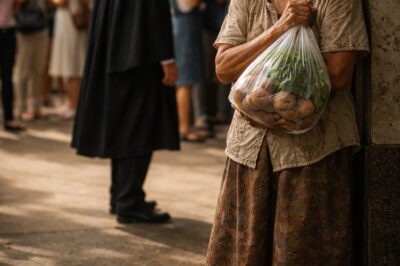
Isang matandang ina ang sumuporta sa kaniyang anak sa pamamagitan ng pag-aaral ng medisina. Noong araw ng pagtatapos, umarkila pa siya ng motorbike taxi para dumalo sa seremonya ng kaniyang anak, ngunit laking gulat niya nang makita niya itong nakasuot ng luma at sira-sirang damit, may dalang mga basket ng patatas at gulay, at masaksihan ang reaksyon ng kaniyang anak, kaya’t natigilan siya…
Noong araw na nagtapos ang anak ko bilang doktor, nagising ako ng alas-3 ng umaga. Hindi dahil sa maagang biyahe…
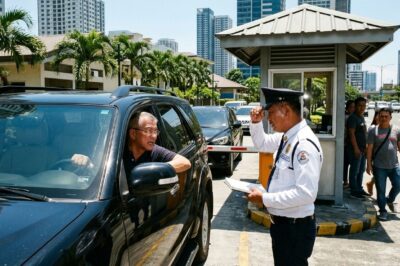
ISANG NAG-IISANG GUWARDYA SA GATE NG ISANG EKSKLUSIBONG SUBDIVISION ANG NAPAHARAP SA MATINDING GALIT NG ISANG RETIRADONG HENERAL NA NAGRESULTA SA ISANG KOMPRONTASYON
Tumitirik ang araw sa gitna ng sementadong kalsada ng Bonifacio Global City, at tila gustong tunawin ang aspalto sa tindi…

World Bank 2026-2031: Ambisyosong plano o pangarap lang sa papel para sa administrasyong PBBM?
Ang Ambisyosong Plano ng World Bank at PBBM para sa 2026-2031: Bagong Pag-asa o Mabulaklak na Pangako? Sa gitna ng…

VP Sara vs. Kamara: Pananahimik o Paghahanda?
Ang “Last Card” ni VP Sara: Isang Kalkuladong Boycott o Simula ng Krisis sa Konstitusyon? Sa gitna ng tumitinding init…

“HIWALAY NA! Bakit Biglang Naghiwalay si Chie Filomeno at Multimillionaire Boyfriend na si Matthew Lhuillier?”
**HIWALAY NA! Ang Buong Shocking Story sa Paghiwalay nina Chie Filomeno at Multimillionaire Boyfriend na si Matthew Lhuillier — Mula…
End of content
No more pages to load