
Poor Girl Who Collects Scrap Returns Suitcase of Money to Billionaire — A Secret Is Revealed
Chapter 1: The Cold Morning
Winter in Detroit was not gentle.
It did not drift softly like in postcards or holiday movies. Instead, it sliced through the air like invisible knives. The wind screamed through narrow streets, pushing snow across cracked sidewalks.
On one of those sidewalks walked a little girl.
Her name was Laya Monroe, and she was only five years old.
Behind her rattled a rusty cart made of bent metal wires and pieces of wood someone had thrown away. The cart was nearly as tall as she was. Inside were empty bottles, crushed soda cans, and scraps of metal — things the city had already decided were worthless.
But to Laya, they were treasure.
Each bottle could mean a few cents.
Each coin meant hope.
She wore a coat too thin for winter and mismatched gloves — one oversized, the other torn at the thumb. Every breath she exhaled turned into white mist before disappearing into the freezing air.
People passed by.
Some stepped around her cart.
Some looked away quickly.
No one stopped.
No one asked why a child so young was wandering alone in the freezing streets.
Laya didn’t cry.
Crying wasted energy.
Instead, she climbed carefully onto the edge of a trash bin and reached inside.
Glass clinked.
Her fingers burned from the cold.
But when she pulled out two intact bottles, she smiled.
“Mom will like this,” she whispered.
Inside her coat pocket was a folded paper, worn and damp from being opened many times.
It was a prescription.
At the top was her mother’s name:
Evelyn Monroe — Age 32
Below it were complicated medical words Laya couldn’t read.
But she understood the number written at the bottom.
The price.
And it was too much.
Chapter 2: Home Above the Repair Shop
Home was not warm.
Home was a single small room above an old repair shop.
The wooden stairs creaked loudly as Laya dragged her cart up one step at a time. The building smelled like rust, oil, and damp blankets.
Inside, her mother lay on a narrow bed by the window.
Evelyn Monroe was only thirty-two years old, but illness had stolen years from her face.
Her legs no longer moved.
Her hands trembled even in sleep.
Every breath sounded like it had to fight its way out.
“Mom,” Laya whispered.
Evelyn’s eyes opened slowly.
But she smiled.
She always smiled for Laya.
“You’re back already?” she asked softly.
Laya climbed onto the bed beside her.
“I found bottles today,” she said proudly.
Evelyn nodded gently.
“That’s wonderful, sweetheart.”
Laya reached into her pocket and carefully unfolded the prescription.
“I’ll buy the medicine tomorrow,” she said confidently.
“I just need a little more money.”
Evelyn closed her eyes briefly, pain flickering across her face.
“You don’t have to do this alone,” she whispered.
But Laya shook her head.
“I want to.”
She didn’t say the rest.
She didn’t say that sometimes at night her mother cried quietly into the pillow when the pain became too much.
Instead, Laya stood up and walked to the small stove.
“I’ll make soup,” she said.
There was no soup.
Just water in a dented pot.
But she stirred it anyway.
Chapter 3: The Night of Hunger
Later that night, Evelyn slept.
Her breathing was shallow but steady.
Laya counted each breath the way other children counted sheep.
When she was sure her mother wouldn’t wake, she quietly slipped on her shoes.
Her stomach growled loudly.
Behind the repair shop were trash bins from nearby restaurants.
Laya knew which ones sometimes had food.
Tonight she found half a sandwich wrapped in paper.
The bread was hard on the edges but soft in the middle.
She brushed off the snow.
Then she took a small bite.
It tasted like relief.
She ate slowly and carefully.
Then she wrapped the other half again and placed it in her pocket.
“For Mom,” she whispered.
Chapter 4: The Suitcase
The next morning, Laya walked farther than usual.
Past the streets she knew.
Past the stores that sometimes threw away bread.
All the way to the city dump.
Mountains of garbage rose like dark hills.
The air smelled terrible.
But there were often bottles there.
She began searching.
Then she saw something strange.
A black suitcase.
Clean.
Unbroken.
Completely out of place.
She looked around.
No one.
Slowly, she grabbed the handle.
It was heavy.
Very heavy.
Her heart pounded as she opened the latches.
Click.
The suitcase opened.
Inside were stacks of money.
Neatly wrapped bills.
More money than she had ever seen in her entire life.
Laya froze.
Her hands trembled.
For a moment, the cold disappeared.
Her mind filled with impossible dreams.
Medicine for her mother.
Food.
Warm clothes.
A real home.
She closed the suitcase quickly.
Her chest hurt.
“If I take it… Mom won’t hurt anymore,” she whispered.
But then another thought appeared.
Someone searching desperately.
Someone crying.
Someone who lost this money.
Her mother’s voice echoed in her memory:
“If something doesn’t belong to you, it will never bring peace.”
Laya squeezed her eyes shut.
Then she locked the suitcase again.
“I can’t,” she said softly.
And she began dragging the suitcase toward the police station.
Chapter 5: The Long Walk
The police station was almost an hour away.
The suitcase was almost too heavy for her.
Her arms shook.
Snow fell harder.
Cars rushed past, splashing icy slush.
Halfway there, she noticed footsteps behind her.
A man watched from the corner.
“You shouldn’t carry something like that alone,” he said.
Laya didn’t answer.
She kept walking.
The man followed.
“Maybe I can help you,” he said.
Fear filled her chest.
She remembered her mother’s advice.
If you’re scared, keep moving.
So she ran.
Not fast.
But desperate.
The man cursed behind her.
Finally she reached a busy street, and he disappeared.
Chapter 6: The Police Station
Warm air hit her face when the police station doors opened.
Two officers looked up in surprise.
A tiny child.
Dragging a large suitcase.
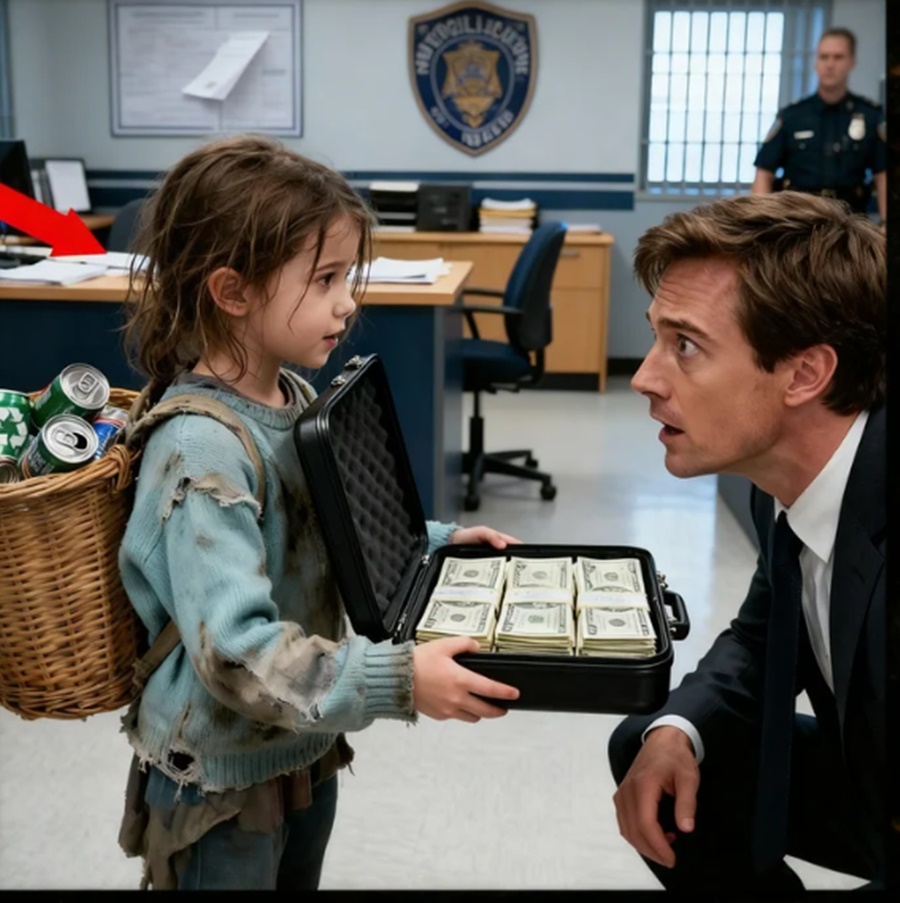
Laya lifted it onto the desk with both hands.
“I found this,” she said.
One officer opened the case.
The room fell silent.
Stacks of cash filled the suitcase.
“You didn’t take anything?” the officer asked gently.
Laya shook her head.
“It wasn’t mine.”
Officer Daniel Brooks stared at her in disbelief.
“You did the right thing,” he said.
Soon they discovered the owner of the suitcase.
A technology billionaire.
Julian Cross.
Chapter 7: The Billionaire
When Julian Cross heard the story, he couldn’t believe it.
A five-year-old girl.
Returning millions of dollars.
He visited her home immediately.
The tiny room shocked him.
The sick mother.
The cold walls.
The empty cupboards.
And the little girl who had refused to keep money that could have saved her life.
Julian’s chest tightened.
“Do you know how much money was in that suitcase?” he asked gently.
Laya shook her head.
“I didn’t count,” she said.
“It wasn’t mine.”
In that moment, Julian made a decision.
He would help them.
Chapter 8: A Dangerous Secret
But the suitcase had exposed something else.
Something darker.
Julian discovered the money had been moved secretly through his company.
Someone had been laundering money.
And the trail led to someone he trusted most.
His cousin.
Vincent Cross.
Vincent had been using shell companies and fake transactions to hide millions of dollars.
And the suitcase Laya found was supposed to disappear forever.
Now the truth was about to come out.
Chapter 9: The Trap
With help from federal agent Maya Rios, Julian set a trap.
Vincent believed Julian would protect the company.
Instead, Julian secretly gathered evidence.
Hidden microphones.
Marked cash.
Financial records.
Finally, Vincent signed documents confirming illegal transfers.
The trap closed.
He was arrested.
Charged with:
• Money laundering
• Conspiracy
• Witness intimidation
All because one little girl refused to keep a suitcase.
Chapter 10: A New Beginning
Months later, spring arrived.
Evelyn Monroe sat up in a hospital bed for the first time in months.
Her treatment had worked.
Her daughter ran into her arms.
“You’re warm,” Laya whispered.
Outside the room stood Julian Cross.
Watching quietly.
Weeks later, another courtroom gathered.
But this time, it wasn’t about crime.
It was about family.
The judge smiled at Laya.
“Do you understand what adoption means?” she asked.
Laya nodded.
“It means,” she said slowly,
“I don’t have to be brave alone anymore.”
The judge’s gavel tapped.
Adoption approved.
Julian Cross became her father.
Epilogue
One evening in her new home, Laya unpacked her old things.
Among them was the torn winter coat she once wore while collecting scrap.
“You don’t need that anymore,” Julian said gently.
Laya folded it carefully.
“I know,” she said.
“Then why keep it?”
She looked up at him with wise eyes.
“So I remember what cold feels like,” she said.
“And what I didn’t take when I was hungry.”
Julian hugged her tightly.
Because sometimes the smallest act of honesty can change the lives of everyone around it.
Stories across cultures often highlight how honesty and selflessness lead to justice and respect, showing that integrity can ultimately triumph over greed and deception.
And in this case, it all started with a five-year-old girl… and a suitcase full of money.
News
ISANG BATANG YAGIT ANG HULI SA AKTO NG PAGNANAKAW SA MADULAS NA PALENGKE NG DIVISORIA NA NAGDULOT NG TENSYON NANG KALADKARIN SIYA NG KINATATAKUTANG GWARDYA, NGUNIT ANG LIHIM NA PAGSUNOD NG ISANG TINDERO AY MAGBUBUNYAG NG KAKAIBANG ANYO NG HUSTISYA
Isang batang magnanakaw ang nahuli sa abalang pagnanakaw sa maingay na pamilihan ng Divisoria, na lumikha ng tensyon habang kinakaladkad…

Manny Pacquiao Has Something Bad to Do with Jillian Ward? Emman Bacosa Completely Deletes the Actress from His Life After Discovering That the Girl Has Another Man’s Attention!
In the world of showbiz and sports, it seems that nothing is more explosive than the news involving a Pacquiao…

HABANG LUMULUBOG ANG BAYAN SA TAAS-PRESYO… ISANG ARTISTA ANG GUMAWA NG HINDI INAASAHAN — ANG LIHIM NA DESISYON NI DONNY PANGILINAN NA NAGPAIYAK SA MGA DRAYBER AT NAGPA-ASA SA LIBO-LIBONG PILIPINO
Habang Lahat Nagtaas… Si Donny Pangilinan Nagbaba Para sa Tao. HABANG LUMULUBOG ANG BAYAN SA TAAS-PRESYO… ISANG ARTISTA ANG GUMAWA…

Viral Controversy Clarified: The Truth Behind the Alleged Incident Involving Jeric Raval and Kylie Padilla
In the fast-moving world of entertainment, where headlines are often driven by speculation and amplified by social media, it takes…

https://av.weeknews247.com/aviet/unang-panalo-nabuksan-ang-iran-blockade-balik-export-na-ang-iraq-at-saudi-sa-gitna-ng-matinding-tensyon-sa-strait-of-hormuz-at-krisis-sa-pandaigdigang-merkado-ng-langis/
In the ever-evolving world of Philippine entertainment, few on-screen partnerships have captured the imagination of fans quite like Kim Chiu…

Unang Panalo! Nabuksan ang Iran Blockade: Balik Export na ang Iraq at Saudi sa Gitna ng Matinding Tensyon sa Strait of Hormuz at Krisis sa Pandaigdigang Merkado ng Langis
Sa gitna ng tila walang katapusang gulo at tensyon sa Gitnang Silangan, sa wakas ay may magandang balitang sumalubong sa…
End of content
No more pages to load