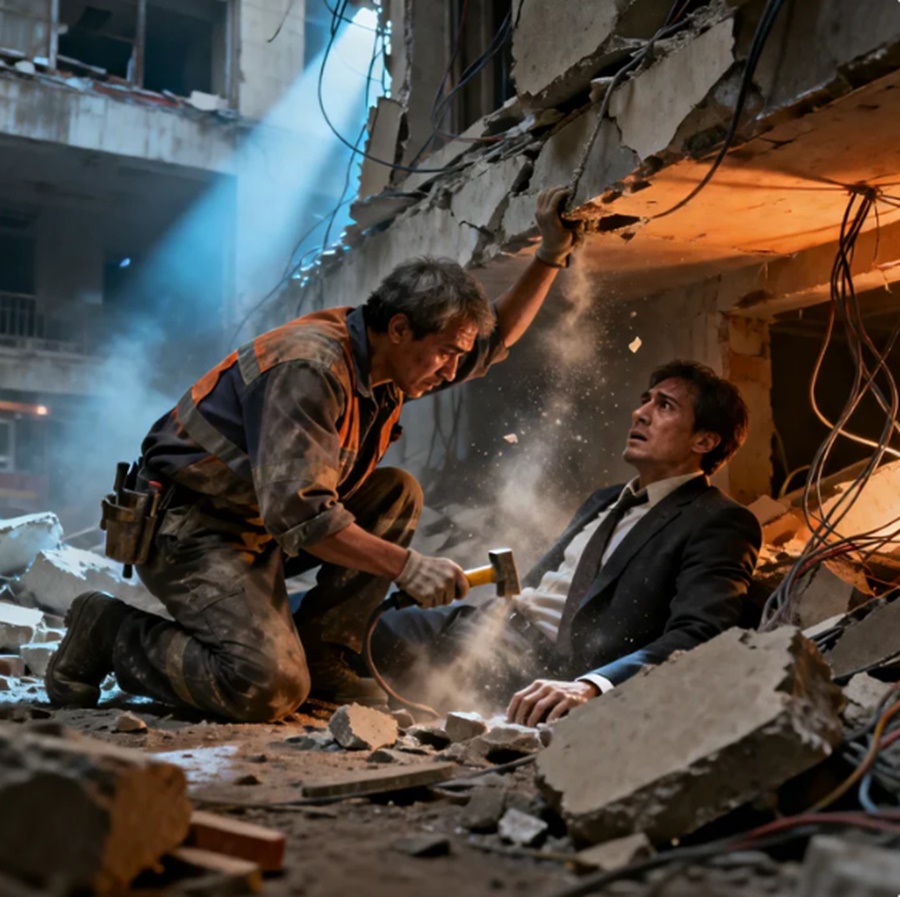
 Maria had only been thinking about getting home before night swallowed the streets.
Her shift had ended late, like it always did. The office toilets, the glass doors, the stair rails—she had scrubbed them until her fingers stung and her shoulders felt like they were carrying stones. Now she walked with a small nylon bag hanging from her arm, her faded cleaning uniform still on her body, slippers slapping against the dusty road. The evening sun sat low, turning Lagos orange and restless.
Then a sound cut through everything.
Not a car horn. Not street traders. Not the crowd that had started gathering ahead.
“Help! Please—somebody help me!”
The voice came from inside the collapsed building.
From under the rubble.
Maria stopped so fast her breath caught. The building lay in pieces like a giant had slammed his fist down on it—cement blocks scattered, iron rods sticking out like broken bones, wood splintered, dust hanging in the air. People had formed a wide circle around it, staring as if it were a movie screen. Some held their heads. Some covered their mouths. Some raised phones to record. Nobody moved closer.
A woman near Maria whispered, “Ah, this thing is dangerous. If you enter, it can fall again.”
Another man shouted, “Call emergency! Call fire service!”
Someone answered, frustrated, “We called. They said they’re coming.”
The trapped man screamed again, louder this time, panic making his words sharp. “Please! I can’t breathe well! I’m trapped!”
Maria’s heart began to pound like it was trying to break out of her chest. She didn’t know this man. She didn’t know his name or his story. She didn’t know if he was kind or cruel, rich or poor. She only knew one thing: he was alive, and he was running out of time.
She stepped forward—and a big man immediately blocked her path, both hands out like a wall.
“Madam, no go there,” he warned, shaking his head hard. “See everywhere weak. If you enter, it fit bury you too.”
Maria stared up at him, eyes wide. “So we should just watch him die?”
The man’s mouth opened, then closed. He had no answer.
The voice under the rubble turned weaker, like it was being pulled away. “Please… I beg you…”
Something inside Maria tightened. A memory flashed—her late mother’s voice, firm even when they had nothing: When people are scared, do the right thing anyway. God will carry your courage.
Maria slid past the big man before her fear could pull her back.
“Hey!” someone yelled. “This girl is mad!”
But Maria kept moving.
The smell hit her first—dust, cement, broken wood, and something metallic that made her stomach twist. The building looked like a smashed cake, half of it flattened, the other half leaning dangerously as if one breath could make it fall again. Her hands began to shake, not because she was weak, but because she was terrified.
Still, she moved carefully, step by step, searching for the voice.
“Where are you?” she shouted into the rubble.
A cough answered her. Then the voice again—faint, rough, close. “Here… I’m here…”
Maria crouched low and crawled toward the sound. She found a narrow gap between two heavy blocks. In that gap, a man’s hand reached out, dirty and trembling, fingers stretching as if begging the world to remember him.
Maria swallowed hard and wrapped her fingers around his.
“Hold on,” she whispered. “I’m here.”
His grip tightened weakly, like he was clinging to life through her skin.
Behind her, the crowd gasped.
“She touched him!”
“She’s inside!”
“God, protect her!”
Maria forced herself to focus. She looked around for anything—anything she could use. A long wooden plank lay nearby, cracked but still strong. She slid it under a slab of concrete and tried to lift.
Nothing.
Her arms burned instantly. She tried again, pushing with her body weight.
Still nothing.
The man’s breathing sounded worse now, a wet, struggling sound. Maria’s eyes filled with tears, but she blinked them away. This was not the time for tears.
“Please,” she whispered, not to God, not to people—almost to the rubble itself. “Please move.”
She dug her feet into the ground and pushed harder than she had ever pushed anything in her life—harder than carrying buckets of water as a child, harder than dragging garbage bags down office stairs, harder than life had ever demanded of her.
This time, the concrete shifted—just a little.
The crowd screamed, the sound ripping through the air. But Maria didn’t stop. She pushed again. The slab moved more, sliding enough for her to see his face.
He was young—around forty, maybe. His hair had been neatly cut before dust and panic ruined it. A fine suit clung to him, torn at the shoulder, stained with dirt. His eyes were half-open, blinking slowly. His face was pale, as if strength was draining out of him.
“Sir,” Maria said, voice trembling, “can you hear me?”
His lips moved. “Water…”
Maria turned her head toward the crowd. “Please—someone bring water!”
A woman tossed a small bottle. Maria caught it, opened it with shaking hands, and poured a little into his mouth. He swallowed once, then coughed hard, choking.
“Easy,” Maria murmured, tilting his head the way she’d seen nurses do. “Easy…”
A sudden creak sounded above them.
The building groaned like an angry animal.
Everyone screamed.
“Come out!” someone shouted. “It’s shifting again!”
Maria’s whole body went cold. Dust fell from a weak beam overhead. The beam trembled, threatening. The crowd backed away in fear, feet shuffling, phones dropping.
Maria stayed.
Because the man was still trapped.
She scanned quickly. His upper body was free, but his legs were pinned beneath a broken slab. He couldn’t crawl out. His eyes rolled back for a second, like he was slipping away.
“No!” Maria breathed. “Don’t you dare leave me now.”
She grabbed the slab with both hands and tried to lift. It was like lifting the whole world. She tried again. Her shoulders screamed. Her arms shook. The slab didn’t move.
Maria’s eyes darted—metal rod. A thick rod lay beside the rubble like a forgotten weapon. She dragged it closer, slid it under the slab, and used it like a lever.
She pressed down with everything she had.
Her teeth clenched so hard her jaw hurt. Sweat and dust mixed on her forehead. A sound ripped out of her throat, half-scream, half-prayer.
The slab lifted—just enough.
Then it shifted.
Then it slid off his legs.
Maria didn’t waste a second. She pulled the man out by his shoulders, dragging him through the gap until his body fell into her arms, heavy and limp. He was taller than her, bigger than her, but she held him anyway, stumbling backward with his weight.
“Sir!” she cried. “Sir, wake up!”
No answer.
He fainted.
Fear knotted in Maria’s stomach. She checked his breathing the way she’d once checked her little brother’s when he had asthma. Shallow… but there.
She stood up, shaking, and half-carried, half-dragged him out of the danger zone. The crowd parted like the sea, staring at her as if she wasn’t real.
“This girl… she’s a human being,” a man muttered, awe in his voice.
“God bless you, my daughter,” another woman whispered.
Maria didn’t respond. She couldn’t. The building behind her cracked again—loud, violent.
Maria turned just in time to see a large section tilt and crash down with a thunderous boom. Dust exploded into the air. People screamed and ran.
Maria stumbled forward, coughing, holding the unconscious man tighter.
If she had stayed two seconds longer…
She didn’t finish the thought.
Far away, a siren finally wailed. An ambulance forced its way through traffic, honking. Two nurses jumped out, followed by a doctor.
“Where is he?” the doctor shouted.
Maria ran toward them, arms trembling. “Here! He was trapped—he fainted!”
The doctor’s eyes widened as the nurses took the man from her and laid him on a stretcher. “You brought him out alone?”
“There was no time,” Maria said, breathless. “Please save him.”
As they rolled him toward the ambulance, the doctor glanced at Maria’s dusty uniform, at her cracked slippers, at her eyes that looked older than her years. “Who is he? Do you know his name?”
Maria swallowed. She looked down at the man’s wrist—and only then noticed the watch. Even covered in dust, it looked like money. It looked like a life she had never lived.
“I… I don’t know his name,” she admitted.
The doctor nodded briskly. “We’ll do our best.”
They pushed him into the ambulance. Maria stood there for half a heartbeat, hands suddenly empty, feeling the cold air where his weight had been.
Then, without thinking, she climbed in after them.
“Madam, you can’t enter,” a nurse warned.
Maria held the door. “Please. I saved him. I need to know he survives.”
The nurse hesitated, then looked at Maria’s face—the fear, the exhaustion, the stubborn care—and finally nodded. “Sit down.”
The door slammed. The siren rose again. The ambulance cut through Lagos like a sharp blade, lights flashing.
Maria stared at the man’s face as nurses worked around him. And right as she leaned forward, his fingers twitched. His eyes fluttered open for one second.
In a voice so weak it was almost air, he whispered one word:
“Maria.”
Maria went completely still.
Her blood turned cold.
She had never met this man before.
So how—how did he know her name?
The hospital was bright and harsh after the dust and chaos. Nurses rushed him through corridors, shouting medical words Maria didn’t understand. Trauma room. Oxygen. Monitor. Move.
A security guard blocked her at the emergency doors. “You can’t go in,” he said.
“But I brought him,” Maria pleaded. “I saved him.”
The guard hesitated. “Wait here.”
The doors shut. Maria sat on a plastic chair in the hallway, staring at the red light above the emergency room. She didn’t care that her clothes were dirty. She didn’t care that she was tired. She couldn’t even feel her body anymore—only her mind, looping the same moment again and again: the hand under the rubble… the creak above her head… the slab lifting… the whisper.
Maria.
Minutes passed. Then hours.
Night dropped outside. The hallway grew quiet in the way hospitals do—quiet but never peaceful. People cried softly. Phones buzzed. Doctors whispered. Maria didn’t move.
At midnight, a doctor finally came out, face tired.
Maria jumped up. “Doctor!”
“Are you the woman who brought him in?”
“Yes,” Maria said quickly. “Is he okay?”
The doctor exhaled. “He is alive. But his condition is serious. Internal injuries. His spine took a hard hit. And he lost oxygen while trapped.”
Maria’s knees weakened. “Can he walk again?”
“It’s too early to tell,” the doctor said honestly. Then he studied her for a moment, as if weighing her heart. “You can see him for a minute. ICU only.”
Maria followed quietly into the dim ICU. Machines beeped softly. The man lay in a clean white bed now, wires on his chest, oxygen mask rising and falling. Without the dust, he looked even more out of place—like someone whose life was usually protected.
Maria stood beside the bed, hands clasped so tight her fingers hurt.
“Please wake up,” she whispered. “You didn’t survive all that just to die here.”
She stayed.
Morning came. Then afternoon. Then night again.
On the third day, the beeping changed. Nurses rushed in. A doctor followed.
Maria’s heart jumped.
The man’s fingers twitched. His eyes opened slowly, unfocused at first. “Water,” he whispered.
“He’s awake,” Maria breathed.
The doctor leaned in. “Easy. You’re safe.”
The man blinked, eyes moving around the room until they landed on Maria. He stared at her like he had been searching for her in the dark.
“You,” he whispered, emotion cracking through the weakness.
Maria nodded, tears rising. “Yes. I’m here.”
He shifted slightly, wincing. “Thank you,” he murmured. “You saved me.”
Maria shook her head. “I just did what anyone should do.”
He tried to smile, but it came out tired. “What’s your name?”
Maria swallowed. “Maria.”
His eyes softened, like the name was already familiar. “I’m Dennis,” he said. The doctor gently interrupted, telling him to rest. Before Dennis’s eyes closed again, he whispered, “Please… don’t leave.”
Later that day, the hospital doors burst open.
“Where is Mr. Dennis?” men shouted. “We’ve been searching everywhere!”
A group of men in suits rushed down the hallway, followed by security with sharp eyes. Behind them came a woman in heels, crying as she walked.
“My brother,” she sobbed. “Oh my God…”
Maria stepped back, confused, suddenly feeling small.
One of the men straightened his jacket and faced the doctor. “I’m his chief of staff. This is his legal adviser. That is his head of security.”
Maria’s breath caught.
The chief of staff turned to her. “You saved Mr. Dennis?”
Maria nodded slowly. “He was trapped. I—yes.”
The man’s eyes widened. “Do you know who he is?”
Maria’s mouth went dry. “No.”
He took a deep breath, as if preparing her for a fall. “He is Dennis Adabio. Billionaire CEO of Adabio Holdings.”
The world tilted.
Maria stared at Dennis’s face—the same face she had pulled from death, the same hand she had held beneath concrete—and suddenly everything looked different. The watch. The suit. The people.
Billionaire.
In that moment, Dennis opened his eyes again. He saw the crowd around him, the suits, the tears, the power pressing close. Then he looked at Maria.
“She stays,” he said clearly.
The room went silent.
His sister stared. The men in suits exchanged looks. The doctor cleared his throat.
Dennis tightened his grip on Maria’s hand. “She stays,” he repeated, firmer.
And Maria—dusty, tired, shaking—realized the whisper in the ambulance wasn’t magic after all. As she shifted, she caught sight of her uniform sleeve in the bright hospital light. The stitched name tag, faded but readable.
MARIA.
Dennis must have seen it when she pulled him close. In the rubble. In the ambulance. In the chaos.
He didn’t know her story.
But he had seen her name.
And he had felt her courage.
What Maria didn’t understand yet was that saying her name out loud wasn’t just gratitude.
It was the beginning of a storm—one that would lift her out of the life she’d been surviving, and test whether a heart like hers could survive the weight of power, money, and people who feared change more than they respected kindness.
News
Sa unang pagkakataon na nakita ko ang aking ina na tinusok ni Ama ng kawit na bakal sa kanyang balagat, tumawa lang ako nang parang tanga. Habang nakangisi, tahimik kong isiningit ang matalas na basag na laryo sa loob ng aking manggas.
Ang Pagbabalik ng Nawawalang Tiangco Sa unang pagkakataon na nakita ko ang aking ina na tinusok ni Ama ng kawit na…
Nang sabunutan ako ng asawa ko at baliin ang aking binti, nagbigay ako ng senyas sa aking apat na taong gulang na anak. Idinial niya ang lihim na numero at sinabi
Nang sabunutan ako ng asawa ko at baliin ang aking binti, nagbigay ako ng senyas sa aking apat na taong…

BINUNTIS KO ANG MISIS KO DAHIL NALAMAN KONG MAY NAGKAKAGUSTO PA RIN SA KANYA
BINUNTIS KO ANG MISIS KO DAHIL NALAMAN KONG MAY NAGKAKAGUSTO PA RIN SA KANYA DEAR KUYA MID, Hindi ko alam…
DAHIL WALANG MAALALA ANG DALAGA,INUWI ITO NG GWAPONG NBI AGENT PARA BIGYAN NG PANSAMANTALANG TIRAHAN. PAGTIRA SA BAHAY NITO KAPALIT NG SERBISYO NG DALAGA .NGUNIT PAANO KUKUNTRULIN NG BINATA ANG SARILI KUNG MAKAILANG ULIT NA NITONG NAAABUTAN,NA WALA ITONG SAPLOT HABANG NALILIGO SA CR NITO?
DAHIL WALANG MAALALA ANG DALAGA,INUWI ITO NG GWAPONG NBI AGENT PARA BIGYAN NG PANSAMANTALANG TIRAHAN. PAGTIRA SA BAHAY NITO KAPALIT…

Ang asawa ay sumailalim sa operasyon upang baguhin ang kanyang mukha para makatakas sa mapang-abusong asawa—ngunit nang bumalik siya upang maghiganti, nabigla siya sa katotohanang kanyang natuklasan…
Ako si Lia. Tatlumpung taong gulang. Kung makikita mo ako ngayon sa Quezon City, malamang iisipin mong isa akong babaeng…
Habang binabasag ang pinto para “turuan ng leksyon ang kanyang tamad na asawa,” natumba ang asawa nang makita ang nakapangingilabot na katotohanan sa sahig…
Tumilapon ang kandado sa sahig nang sumipa si Hoàng sa pintuan—isang malakas, galit na galit na sipa na parang gustong…
End of content
No more pages to load