🌍✨ NINE HEARTBEATS OF HOPE: HOW HALIMA CISSÉ MADE HISTORY AND REDEFINED POSSIBILITY
When the monitors first picked up the faint, overlapping thrum of multiple heartbeats, the medical team in Bamako thought the machine was malfunctioning. One… two… three… the count kept climbing. By the time the sonographer stopped, there were nine tiny rhythms flickering on the screen.
That day in early 2021, Halima Cissé, a 25-year-old woman from Timbuktu in northern Mali, entered medical history. She was barely halfway through her pregnancy, but already doctors suspected something extraordinary. At first, they believed she was carrying seven babies. Even that would have been unprecedented in West Africa. But the truth was more astonishing than anyone imagined.
A Pregnancy That Defied Odds
Halima and her husband, Kader Arby, had been thrilled simply to learn they were expecting again. They already had a little daughter and were living quietly in Timbuktu, far from the capital’s hospitals. But as her abdomen grew rapidly in size, local doctors urged her to seek specialized care in Bamako.
There, advanced scans revealed multiple fetuses—so many that doctors struggled to count them clearly. The government of Mali, realizing the pregnancy was beyond the capacity of its facilities, stepped in. The Ministry of Health arranged to transfer Halima to Ain Borna University Hospital in Casablanca, Morocco, which had one of North Africa’s most advanced neonatal units.
It was an extraordinary measure: the Malian state chartered a medical flight, covered all expenses, and assembled a multinational team of obstetricians, neonatologists, and anesthesiologists.
“From the beginning, we knew this was not only a Malian story,” said Professor Youssef Alaoui, head of obstetrics in Casablanca. “This was a human story—a medical challenge that united us all.”
Preparing for the Impossible
Even under ideal circumstances, carrying triplets or quadruplets is dangerous. A pregnancy of nonuplets—nine babies—had never before produced nine surviving infants. The risks included pre-eclampsia, hemorrhage, preterm labor, and extreme malnutrition for the fetuses.
Every week brought new challenges. Halima’s heart worked harder; her lungs struggled for space. She could barely sleep. Yet her spirit, those around her said, never wavered.
“She was calm, almost serene,” recalled nurse Amina Ben Hadi. “When the doctors explained the risks, she smiled and said, ‘God has written this; He will guide it.’”
The plan was to reach 30 weeks of gestation—still far earlier than a full-term 40 weeks but long enough to give the babies a fighting chance. As April 2021 began, the team prepared for what they called “Day N.”
May 4, 2021: The Day the World Watched
At 11:30 a.m., Halima was wheeled into the operating theater. Two dozen specialists filled the room: five obstetricians, ten nurses, anesthetists, and neonatal resuscitation teams positioned at nine incubators lined up like soldiers in formation.
The Caesarean section took less than 20 minutes. One by one, the babies emerged—tiny, fragile, but alive.
“We counted: one… two… three… and we kept going,” said Dr. Alaoui afterward. “When we reached nine, there was a moment of complete silence. Then we heard the cries—so many cries. It was the most beautiful noise.”
Halima gave birth to five girls and four boys, weighing between 500 grams and 1 kilogram (about 1.1 to 2.2 pounds). Each was immediately transferred to an incubator for oxygen and intravenous feeding. Despite their prematurity, all nine displayed strong heartbeats.
The delivery shattered the previous world record—set in the United States in 2009 when Nadya Suleman, “Octomom,” gave birth to eight surviving infants.
Names, Faces, and Hope
In Bamako, news broke within hours. Radio stations interrupted programming; social media filled with congratulations. The Malian government issued a statement celebrating “a national and global miracle.” President Bah N’Daw phoned the hospital personally to commend the medical team.
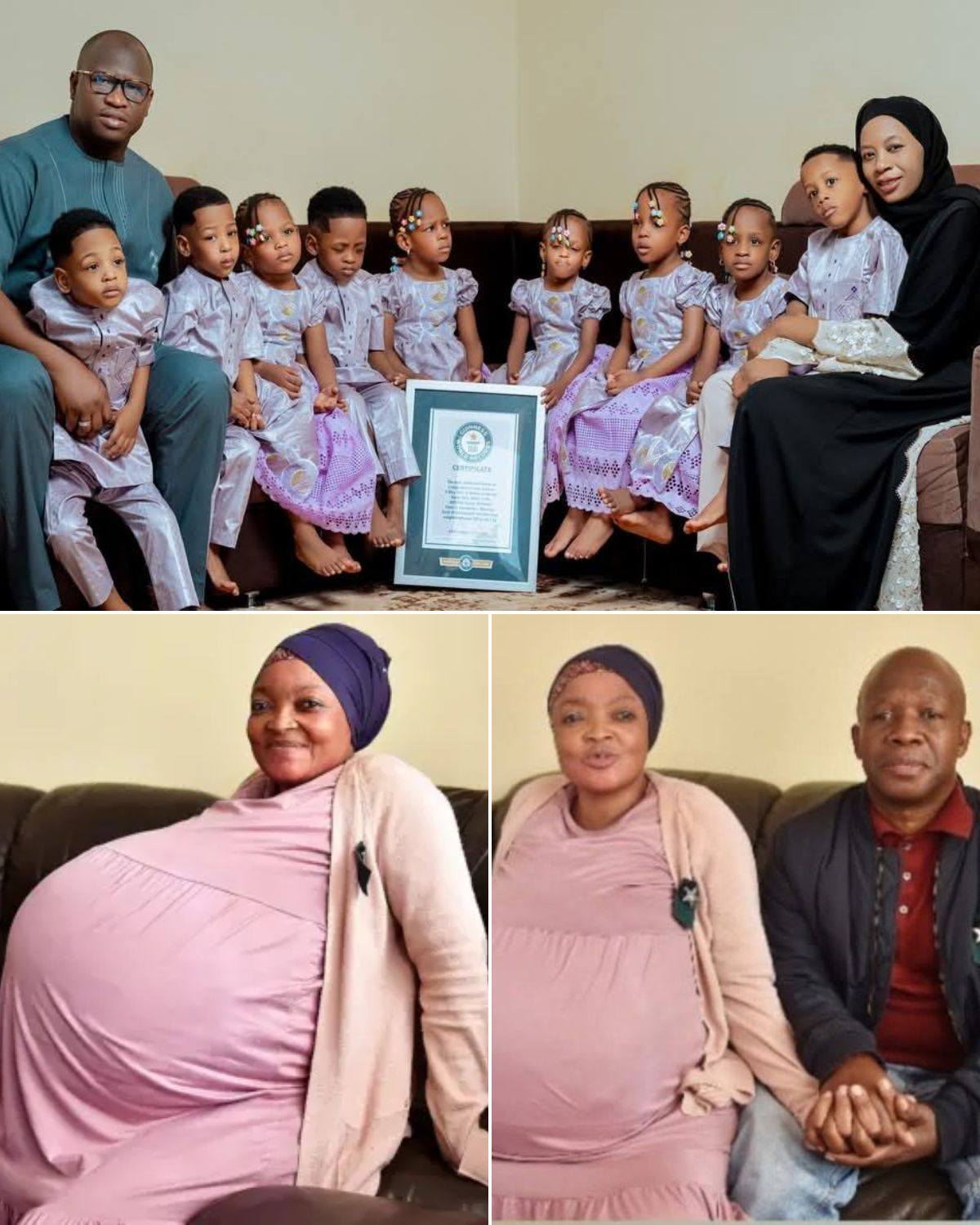
The babies were later named: Kadidia, Fatouma, Hawa, Adama, Oumou, Bah, Mohammed VI, Elhadji, and Oumar. Each name carried a piece of family and faith—blessings drawn from Islam, Mali, and Morocco alike.
“Every child has a meaning,” Kader Arby told reporters. “Together they mean gratitude.”
For months, the infants remained in Casablanca’s neonatal ward under round-the-clock care. Photos released later showed them lined up in a row of incubators—nine tiny miracles wrapped in color-coded blankets.
The Science Behind a Miracle
Multiple pregnancies of this magnitude almost always result from fertility treatment, but Halima had conceived naturally—another medical rarity. Scientists estimate the odds of spontaneous nonuplets at one in several billion.
Dr. Alaoui explained that during early development, Halima released multiple eggs, all of which were fertilized and implanted successfully. “The probability is so small it is almost theoretical,” he said. “To see it, and to see them all alive, is something none of us will forget.”
The case offered doctors valuable insight into prenatal nutrition, uterine capacity, and neonatal micro-care. “We learned as we went,” admitted pediatrician Leila Zerhouni. “But we also learned that medicine still has room for awe.”
Life After the Headlines
When the family returned to Mali the following year, the babies were thriving—tiny but strong, each weighing between 6 and 11 kilograms. Crowds lined the streets of Bamako to welcome them home.
The Malian government continued to support the family financially, covering housing and medical costs. Volunteers arrived with diapers, formula, and clothing. The children’s arrival inspired local charities to launch “Project Nine Stars,” a program providing care for premature infants across West Africa.
Halima, once an ordinary woman from Timbuktu, became a symbol of perseverance. In interviews, she expressed gratitude rather than exhaustion.
“People call it a miracle,” she said softly. “I call it responsibility. God gave them to me; I must give them everything.”
Her husband balanced humor with humility. “When they all cry at once,” he joked, “it’s like being in a football stadium.”
Challenges Behind the Joy
Raising nine infants is no fairy tale. The family relies on nurses working shifts around the clock. Feeding schedules resemble military operations: bottles sterilized in batches, charts tracking ounces consumed.
Sleep is rare. Silence, rarer. But the household hums with warmth.
Neighbors describe constant laughter, music from the radio, and children’s giggles echoing from every room. “They’re like a small school,” said one neighbor. “You can’t pass the house without smiling.”
Doctors continue to monitor the children’s growth carefully, studying them as an unprecedented case of shared development. “So far they are healthy, meeting milestones,” said Dr. Alaoui during a follow-up visit. “We hope their story brings attention to maternal health everywhere.”
The Global Ripples
Halima’s pregnancy reignited global discussion about maternal care in developing nations. Mali, where maternal mortality remains among the world’s highest, faces chronic shortages of doctors and prenatal facilities.
International organizations cited her story as proof that with coordination and resources, even fragile healthcare systems can achieve miracles. “When governments invest in women’s health, the whole nation benefits,” said WHO regional director Dr. Matshidiso Moeti.
Her story also resonated culturally. In Mali, large families are viewed as blessings, but the sheer scale of nine newborns captured imaginations worldwide. “She became a symbol of abundance and faith,” said sociologist Fatou Traoré. “In a time of loss and pandemic, the world needed good news.”
Guinness World Record Recognition
In late 2021, Guinness World Records officially recognized Halima Cissé as the woman who gave birth to the most surviving children in a single delivery. The certificate now hangs in the family’s living room in Bamako—a simple white frame surrounded by nine tiny handprints in paint.
When asked how it feels to hold a world record, Halima laughed. “I don’t think about records,” she said. “I think about diapers.”
Lessons of Faith and Medicine
Medical experts call the case both inspirational and cautionary. Nonuplet pregnancies carry enormous risks; even with advanced care, survival is uncertain. But they also highlight progress in neonatal medicine—the precision of incubators, the power of nutrition therapy, the dedication of medical teams.
Dr. Alaoui often tells younger colleagues that the real miracle wasn’t just biology; it was cooperation. “It took two countries, dozens of professionals, and one woman’s courage,” he said. “That’s how miracles happen—through teamwork.”
A Mother’s Reflection
Three years later, Halima still begins each morning the same way: by checking nine tiny beds, adjusting blankets, whispering prayers. The babies—now toddlers—are learning to walk, talk, and argue over toys.
“They have nine different personalities,” she said recently. “One is calm, one is loud, one eats too fast, one too slow. But they all look after each other.”
When asked how she manages, she smiled: “With help. With faith. And with a very big calendar.”
The Legacy
Halima Cissé’s story continues to echo beyond Mali. In classrooms, her case appears in medical textbooks; in maternity wards, her name inspires young nurses.
For mothers everywhere—those expecting one child or many—her journey is a reminder of both fragility and resilience, of how life can astonish even those trained to measure it scientifically.
“Nine babies, all alive,” said Dr. Zerhouni, shaking her head. “We count heartbeats every day, but that day we counted hope.”
And in a small house in Bamako, as the evening call to prayer drifts through the windows, nine voices answer—laughing, crying, living proof that miracles sometimes arrive not as one gift, but as nine.
News
“Isinilang akong muli upang iligtas ang aking anak na babae, ngunit nangyari pa rin ang lahat ng kasawian: nabunyag ang nakapangingilabot na katotohanan—ang taong nasa likod ng ‘panghihiram’ sa kanyang swerte ay ang taong pinakapinagkakatiwalaan ko!”
Tatlong araw matapos kong ipanganak ang aking anak na babae, nanganak din ang aking pinsan ng isang babae. Ang pangalan…
Isang istriktong guwardiya sa istasyon ng MRT ang walang atubiling kinumpiska ang isang kahon ng Tupperware mula sa isang umiiyak na estudyante na kapos sa pamasahe, dahil sa hinala nilang kontrabando ito. Ngunit nang aksidenteng mabuksan ang kahon sa harap ng mga nagrereklamong pasahero, isang nakakadurog ng puso ang nabunyag…
Isang istriktong guwardiya sa istasyon ng MRT ang walang atubiling kinumpiska ang isang kahon ng Tupperware mula sa isang umiiyak…

SUPREMA NA KAHIHIYAN! TAMBALUSLOS, NILANGAW SA SAMAR! MARTIN ROMUALDEZ, PINAGTAWANAN NG MGA PLASTIC NA UPUAN; “WALA NANG NANINIWALA!”
TACLOBAN, LEYTE – Mukhang hindi na uubra ang bagsik ng kapangyarihan at kinang ng ginto! Sa gitna ng mainit na usaping…

“Krisis sa Gitnang Silangan: Inilunsad ng Pamahalaan ng Pilipinas ang Serye ng mga ‘Pang-emerhensiyang Hakbang’ – Ano ang Mapapakinabangan ng mga Tao?”
Agarang kumilos ang pamahalaan sa ilalim ng pamumuno ni Pangulong Ferdinand R. Marcos Jr. upang maibsan ang epekto ng kaguluhan…

Impeachment ni VP Sara: Bakit “Mission Impossible” ang Patalsikin ang Ikalawang Pangulo?
Sa gitna ng umiinit na tensyong pulitikal sa Pilipinas, isang malaking katanungan ang bumabalot sa bawat sulok ng bansa: Matutuloy…

NAWALA O NINAKAW?! ANG MAHIWAGANG PAGLAHO NG MGA GINTO NI MARCOS SA NEW YORK AT BSP—MGA BILYONARYONG KONSPIRASYON, IBINULGAR NA!
Saan napunta ang kinang ng bilyon-bilyong halaga ng ginto? Habang ang buong mundo ay nakatitig sa ekonomiya ng Pilipinas, isang…
End of content
No more pages to load