My Niece Dumped Scraps on My Plate and Called Me the Family’s Army Trash—By Midnight, My Parents Learned Exactly How Much Their Civilian Lives Depended on My Name
My Niece Dumped Scraps on My Plate and Called Me the Family’s Army Trash—By Midnight, My Parents Learned Exactly How Much Their Civilian Lives Depended on My Name
Part 1 — At a Holiday Brunch Near Fort Liberty, One Child Repeated the Insult My Entire Family Had Been Too Cowardly to Say
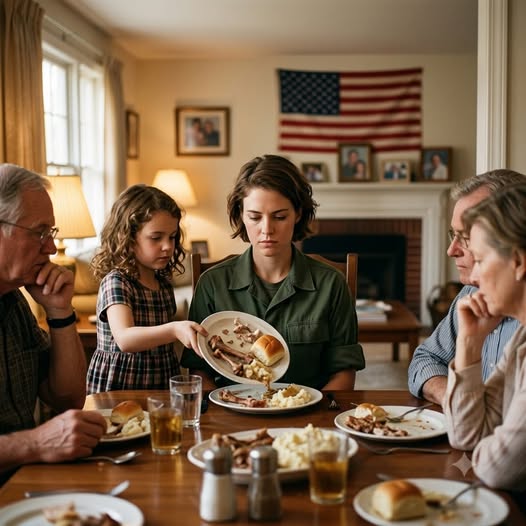
The fork in my hand stopped when my niece scraped her plate over mine.
A torn biscuit slid first. Then bacon she had bitten and abandoned. Then gravy spread across my eggs.
Ten-year-old Madison looked straight at me.
“Mom says Aunt Rachel is the Army trash can. Everybody dumps stuff on you because you always take it.”
The table went silent for two seconds.
Then Dad reached for the coffee.
Mom studied her napkin.
My younger sister, Kendra, gave Madison a warning look—not because the words were cruel, but because her daughter had repeated them in front of me.
We were eating the Sunday brunch after Christmas at my parents’ house in Spring Lake, North Carolina, fifteen minutes from Fort Liberty. I had driven over after handling an early-morning call from one of my soldiers whose car had broken down on Interstate 95.
I had spent eighteen years in uniform. I knew how to stay calm when things went wrong.
So I set down my fork and asked one question.
“Did you hear your mother say that?”
Madison nodded.
Kendra snapped, “She’s ten, Rachel. Don’t interrogate her.”
“I asked one question.”
Mom sighed.
“Can we not turn brunch into one of your command briefings?”
That was the moment something inside me went cold.
I stood, carried my plate to the kitchen, dumped the food, and rinsed it clean.
Before leaving, I looked around the house.
The refrigerator I had replaced.
The recliner I bought after Dad’s knee surgery.
The router blinking beside the television because the internet account was still mine.
Kendra’s keys to a white Subaru Ascent sat on the counter. I had financed it three years earlier after her credit collapsed and she insisted Madison needed a safer vehicle.
Mom’s phone was on my account.
So was Dad’s.
So was Kendra’s.
So was Madison’s tablet.
I had never noticed how much of me was scattered around that house until the people using all of it sat silent while a child called me their trash can.
At 8:41 that night, Mom removed me from the family group chat.
Her last message stayed visible long enough to read.
If the Army is the only family you respect, then stay with them. We are done with your attitude.
Dad reacted with a thumbs-up.
Kendra added a red heart.
I stared at the screen.
Then I typed one reply.
Copy that. Everything under my name stands down tomorrow.
For nine years, my family’s finances had operated like a failing unit.
Me.
The Spring Lake house was legally mine. I had bought it with a conventional mortgage after Dad’s warehouse injury cut his income. My parents paid me $500 a month. The mortgage, taxes, and insurance cost more than $2,100.
I covered the rest.
Kendra’s Subaru loan was in my name because the lender would not approve her alone. I paid the insurance.
Their four phone lines were mine.
The internet was mine.
The fuel card Dad used for medical appointments was an authorized card on my credit account.
I paid Madison’s robotics program and part of her dance tuition.
I also sent Mom $600 after she reduced her work hours.
There had been no single agreement to finance their lives.
It happened one emergency at a time.
A transmission.
A tax shortage.
A school deposit.
A prescription.
A “just until next month” payment that never ended.
At 10:17 p.m., I opened a spreadsheet and listed every recurring expense connected to them.
Last year alone, I had spent $38,460 supporting a household I did not live in.
That did not include mortgage principal on a house they casually called “Mom and Dad’s place,” though my name was the only one on the deed.
I did not shut off utilities or cancel insurance on a vehicle legally tied to me.
I did what Army logistics had trained me to do.
Document. Separate obligations. End unnecessary support.
I froze the authorized fuel card.
I stopped the extra $600 transfer to Mom.
I scheduled Madison’s activity payments to end after the current month.
I requested that the four phone lines split so they had time to transfer their numbers.
I changed the internet account so the next cycle required a new payer.
For the Subaru, I emailed the lender asking about refinance, transfer, or surrender options.
For the house, I kept the mortgage current and requested an appointment with Fort Liberty legal assistance to end my parents’ discounted occupancy agreement lawfully.
At 11:52 p.m., Dad tried the fuel card.
Declined.
At 12:06, Mom noticed the canceled transfer.
At 12:14, Kendra received an automated notice that I had contacted the vehicle lender.
My phone erupted.
By 12:37, I had seventeen missed calls.
Kendra texted, What did you tell the car company?
Mom wrote, Your father needs that card.
Dad sent, You don’t weaponize money against family.
At 12:58, Kendra sent another message.
If you do anything with that house, I swear you’ll regret it.
I read it twice.
Kendra had never lived there.
She had never paid one dollar toward it.
Yet she sounded terrified that I might touch something she believed belonged to her.
At 1:07 a.m., an unfamiliar Fayetteville number called.
A fraud specialist from my bank introduced himself and asked whether I had just attempted to access the Spring Lake mortgage through a new device.
I said no.
He paused.
“Someone entered your Social Security number and date of birth correctly. They failed the security question.”
My hand tightened around the phone.
The question was the name of my first Army duty station.
Only a handful of people knew the answer.
Every one of them had been sitting at that brunch table.
Part 2 — By Dawn, Frozen Cards and Military Legal Papers Turned Their Mockery Into Panic, but My Sister Still Demanded More from Me
At 7:30 the next morning, I was outside the legal assistance office at Fort Liberty with coffee in one hand and screenshots in the other.
Captain Lewis, the legal assistance attorney, made one thing clear immediately: because the house and vehicle were civilian matters, his office could advise me but would not represent me in court.
He gave me a checklist, referred me to a Fayetteville attorney, and told me to preserve every message.
“Do not threaten them. Do not retaliate. Do not give them access to your accounts. Just document and use the proper process.”
I changed every password, enabled new authentication, froze my credit files, and asked the bank to flag the mortgage account.
The fraud team later confirmed the failed login had come from an internet address associated with my parents’ house.
That afternoon, Mom left a voicemail saying the whole situation had been “blown out of proportion.”
Dad texted that families say things when they are angry.
Kendra wrote eight times about the Subaru and not once about trying to access my mortgage.
I finally agreed to meet them at a diner on Bragg Boulevard two days later.
I chose a public place and brought a binder thick enough to make Dad frown the moment he saw it.
He opened with, “This circus ends now.”
Mom said she had barely slept.
Kendra pushed her phone toward me, showing a lender email.
“Fix the car payment first. We can talk about your feelings afterward.”
I placed the binder on the table.
The first section showed nine years of housing costs: mortgage, taxes, insurance, repairs, appliances, and the difference between what my parents paid and what the property actually cost me.
The second held Subaru statements and insurance premiums.
The third contained phone bills, transfers to Mom, school fees, medical purchases, and dozens of smaller expenses they had stopped noticing years ago.
Dad flipped through three pages and went pale.
Mom whispered, “Why would you keep records like this?”
“Because the Army taught me that if nobody signs for the equipment, somebody eventually claims it was always theirs.”
Kendra rolled her eyes.
“So now we’re equipment?”
“No. You’re adults. That is exactly the point.”
I told my parents they would receive formal written notice changing the occupancy terms.
They could pay a fair rent they could actually document and afford, or they could use the notice period to find another place.
I told Kendra she had thirty days to qualify for a refinance on the Subaru.
If she could not, we would arrange a lawful return of the vehicle.
Her chair scraped backward.
“You would take a car from a mother?”
“I would stop carrying a six-hundred-dollar payment for someone who says I’m garbage.”
“You’re punishing Madison for something she repeated.”
Madison had been coloring silently at the end of the booth.
Suddenly she looked up.
“Mom said Aunt Rachel doesn’t need money because the Army gives her everything.”
Kendra’s face hardened.
Madison kept going.
“And she said Grandma’s house will be ours anyway when Aunt Rachel signs the paper.”
Nobody breathed.
I looked at my mother.
“What paper?”
Mom’s eyes filled instantly.
Dad stared at Kendra.
Kendra said, too quickly, “She doesn’t know what she’s talking about.”
Madison frowned.
“The paper from Grandma’s printer. The one Mom said would put the house in Grandma and Grandpa’s names.”
I closed the binder.
My phone buzzed before I could speak.
It was an email from the civilian attorney Captain Lewis had referred me to.
He had checked the Cumberland County property records after I told him about the attempted mortgage access.
A deed-transfer document had been submitted electronically the previous evening.
It had not been accepted.
The notary verification had failed.
But the document contained my typed name, my property address, and a signature that was supposed to be mine.
I turned the screen toward Kendra.
For the first time since this began, my sister stopped asking me to pay for anything.
She just stared at the forged signature.
Part 3 — The House, the SUV, and One Cruel Sentence Finally Forced My Family to Pay for Years of Taking Me for Granted
I did not argue in the diner.
I forwarded the document to my attorney, paid the check, and left.
That afternoon, on his advice, I filed a fraud report with the bank and a police report documenting the attempted transfer.
Three days later, Kendra admitted through her attorney that she had prepared the document.
She claimed Mom and Dad were afraid I would sell the property and that she was only trying to “protect the family home.”
She had found old financial paperwork while staying there, copied information she had no permission to use, and convinced herself that changing ownership was justified because my parents had lived there for years.
Mom insisted she never told Kendra to imitate my signature.
Dad said he thought the paperwork was for me to review.
I believed only part of that.
The failed filing had created a record they could not dismiss as hurt feelings.
My attorney handled the property notices.
The bank locked down the mortgage account.
I kept every payment current because the debt was mine, but the subsidy was over.
Sixty days later, my parents moved into a smaller apartment near Sanford.
It was clean, affordable, and theirs to budget for.
Mom picked up more hours at the medical office.
Dad learned exactly what internet, groceries, and prescriptions cost when I was no longer absorbing the difference.
Kendra failed to qualify for refinancing on the Subaru.
She returned it angry enough to shake.
“You’re really doing this to your own sister?”
I held out my hand for the second key.
“No. I’m finally stopping what I was doing to myself.”
I sold the vehicle through the lender-approved process and cleared the remaining balance.
The attempted deed transfer brought consequences Kendra could not shout away.
Months later, her attorney negotiated a court resolution that included restitution for my legal expenses, probation, and a written acknowledgment that she had no ownership interest in my property.
I did not ask anyone to destroy her life.
I asked the system to record what she had done.
My parents stayed angry for weeks.
Then the anger got expensive.
They bought their own phones.
They paid their own insurance.
They planned for repairs instead of forwarding every crisis to me.
The world did not end.
It simply stopped billing me for their choices.
I listed the Spring Lake house after it was vacant.
Because I had maintained it for years, it sold cleanly.
After the mortgage and closing costs were paid, I put most of the remaining equity into retirement savings and kept part for my move to Colorado after receiving permanent-change-of-station orders to Fort Carson.
The one person I did not cut off forever was Madison.
Four months after the diner meeting, a purple envelope arrived.
I’m sorry I put food on your plate. Mom said mean things and I copied her. I know now it was wrong. I hope you still want to be my aunt.
I called her that night.
“You don’t have to choose sides,” I said. “But you do have to choose how you treat people.”
“I know.”
“And nobody is a trash can.”
“I know that too.”
We started slowly with birthday calls and school updates.
I never paid Kendra’s bills again.
Caring about Madison did not require financing the adult who had taught her contempt.
Nearly a year after that brunch, Mom called without asking for money.
She apologized specifically for staying silent, removing me from the family chat, and treating my help like an entitlement.
Dad apologized a week later.
Kendra never did.
That became her problem, not mine.
On my first Christmas in Colorado, I ate dinner with soldiers from my section who could not travel home.
The table was noisy and crowded with mismatched plates.
Nobody dumped scraps on mine.
At 11:58 p.m., I checked my phone.
No frantic calls.
No failed-payment alerts.
No demands.
For years, my family had called boundaries selfish because my sacrifice was convenient.
The Army taught me something they never had: support is a mission, not a surrender.
And once they told me I was no longer family, I finally stopped confusing love with unlimited access.