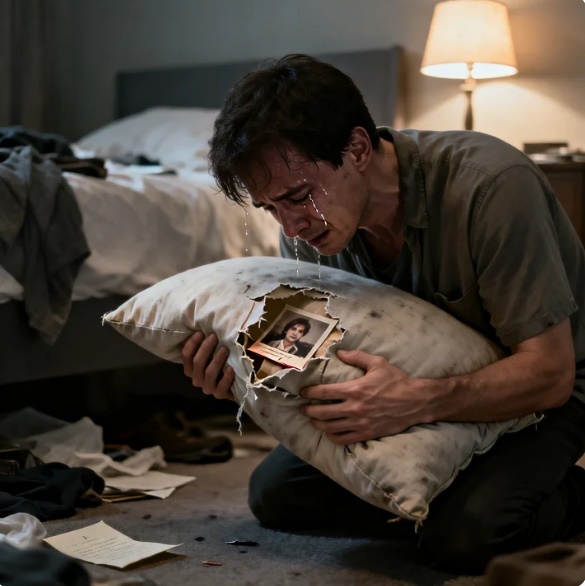
I picked up the old pillow. It was light, lighter than I expected.
But it felt different.
It wasn’t the weight of cotton.
It wasn’t the softness I was used to.
Something hard inside.
I frowned.
I’d touched this pillow many times before, but only now did I feel it—perhaps because I no longer held it with anger, but with a calmness that I didn’t expect.
“You’re really hiding something, Kara…” I whispered.
I took the scissors from the toolbox. Just one cut, I told myself. One cut, and then I’d throw it away.
But when I opened the seam, something fell to the floor.
Not money.
Not jewelry.
Not even a photo.
An old envelope—brown, wrinkled, as if it had been wet and dried several times.
Inside, there were receipts, medical records, and a small blue notebook.
My hands went cold.
The first paper I picked up had the hospital’s stamp on it.
St. Luke’s Medical Center
Department of Oncology
I didn’t immediately understand what it meant.
But when I read the name—
PATIENT NAME: KARLA MAE SANTOS
It felt like something was hitting my chest.
Oncology.
Cancer.
I sat up in bed. I didn’t realize that my knees were shaking. One by one, the papers fell to the floor from my shaking hands.
Stage II.
Stage III.
Chemotherapy schedule.
Radiation therapy.
There was a date.
Two years ago.
Two years.
Two years when he started to get cold.
Two years when he didn’t want to be pampered anymore.
Two years when he suddenly became “stingy.”
I couldn’t breathe.
“No… this isn’t true,” I whispered.
I opened the notebook.
On the first page, his handwriting.
“If you ever read this, Mark, it means I’m no longer home.
I hope, by this time, you’re happy.”
My tears fell onto the paper.
As I read each page, a world slowly opened up that I had never tried to understand.
He wrote everything down.
The first vomiting after chemo.
The hair loss that he hid under a bonnet.
The nights he cried in the bathroom so I wouldn’t hear.
“I don’t want him to see me weak.
Mark has his own battles—the studio, the bankruptcy, his dream of being a good enough man.”
One page was stained with tears.
“If I ask for help, it will only make it harder for him.
So I have to be strong. Even alone.”
I suddenly remembered the nights he wouldn’t come out of the bathroom.
I thought he was acting.
I remembered the times he wouldn’t move.
I thought he didn’t love me anymore.
A page pierced my heart.
“I put the money aside.
Not for myself.
For Mark.”
I looked at the receipts.
A bank account.
In my name.
I don’t know.
At the end of the notebook, there was the most difficult truth.
“The disease is getting worse.
The doctor said I need intensive treatment.
Expensive. Long. Uncertain.”
My chest tightened.
“If I stay, he will use everything he has for me.
He will sell the studio.
He will give the last of his strength.”
One page.
“I can’t stand to see him break down just to keep me alive.”
Another.
“That’s why I have to let him go.”
I burst into tears.
His “coldness”—a wall.
“Being stingy”—a sacrifice.
Her signing the annulment—a final form of love.
“It’s easier for him to hate me, than to love me as I slowly disappear.”
I sobbed.
“Why, Kara… why didn’t you tell me?” I shouted into the empty room.
Under the pillow, there was another thing.
A USB.
Labeled:
“FOR MARK – IF”
I plugged it into my laptop.
There was a video.
Kara’s face appeared.
Thin.
Hairless.
But smiling.
“Hi, Mark,” she said softly.
My world felt like it had collapsed.
“If you’re watching this… it means I’ve succeeded.”
She took a deep breath.
“I chose to be the villain in your story, so that you could be the hero in your own life.”
I was about to cry.
“The money… all my salary… I set aside for you.
So you can get the studio up.
So you don’t have to rely on anyone.”
He paused for a moment.
“And yes… I know Diane.”
My eyes widened.
“I’m not angry,” he said calmly.
“I’m happy that someone makes you smile again.”
I bowed my head in shame.
“But I hope… I hope you don’t let love go to waste.
Because only once does someone come who is willing to get sick for you… and leave to save you.”
The video disappeared.
At the very bottom of the envelope, there was a piece of paper.
A death certificate request form.
Not yet signed.
On the back, his handwriting.
“In case I can’t come back…
I hope you remember me not as the woman who left you,
but as the woman who loved you until the end.”
I collapsed on the floor.
The pillow—not just a pillow.
This was the coffin of everything she hadn’t said.
The next day, Diane arrived.
She smiled, carrying her things.
“Are you ready for a new beginning?” she asked.
I looked around the room.
The bed.
The pillow.
The secrets.
I didn’t answer.
Because finally, I understood—
Kara didn’t leave me.
She set me free.
But the question now…
I didn’t sleep that night.
I just sat on the edge of the bed, holding the old pillow that I once hated, now like a holy relic that I couldn’t let go of. In every fiber of its fabric, I could feel Kara—her breath, her silence, the words she chose to swallow just so I wouldn’t hurt.
Diane was in the living room, busy organizing her things. I heard the sound of hangers, her soft footsteps—the sounds of a new beginning.
But in my chest, something was breaking.
I couldn’t look at her. Not because she was at fault—but because it was finally clear to me how blind I had become.
Around seven in the morning, I stood up.
I took the papers from the envelope.
The medical records.
The name of the hospital.
St. Luke’s Medical Center.
If there’s even a shred of hope…
If there’s even a single percent chance that Kara is still alive—
I need to know.
When I arrived at the hospital, I was greeted by the smell of disinfectant and a heavy silence. This is the place where hope and farewell meet.
I approached the information desk.
“Ma’am,” I said shakily, “I’m looking for Kara Mae Santos. She was… a patient here before.”
The woman looked at the computer. Typed. Paused. Typed again.
There was a long silence.
“Sir,” she said carefully, “when was her last treatment?”
“About… a month ago,” I replied.
She nodded, then looked at me as if she were preparing a weighty statement.
“Just a moment.”
She called a nurse.
A woman in her late forties, with the eyes of someone who has seen pain and loss for a long time.
“Come with me, sir.”
We entered a small office.
“Kara Santos,” the nurse began, “was last admitted here three weeks ago.”
My world stopped.
“Where is she now?” I asked immediately.
She took a deep breath.
“She left… against medical advice.”
“Why?” I asked almost shouting.
“She said she couldn’t take the treatment anymore. And… she left a note.”
She handed me a white envelope.
I recognized the handwriting very well.
Mark,
If you can read this, it means you’ve tracked me down.
I’m sorry if I ran away from the hospital.
I don’t want you to remember me as a woman hooked up to tubes and machines.
I want you to remember me smiling.
There is one place I want to go before it’s all over.
A quiet place. Far away. No doctor.
Don’t look for me.
If you love me even a little bit… let me finish in peace.
—Kara
I didn’t realize I was crying.
“Do you have any idea where he went?” I asked, hoping for a miracle.
The nurse hesitated.
“He mentioned something… a place. Province. Cavinti, Laguna.”
Cavinti.
Suddenly, an old conversation we had came back to my mind.
“I want to live by the lake someday,” he had said.
“That quiet place. That place where time seems to stand still.”
I never went back home.
I never spoke to Diane again. Not because she didn’t have the right—but because I had a debt to pay. A debt to the person who loved me more than himself.
I drove to Laguna.
While traveling, I kept asking myself:
Do I still have the right to look for her?
Or am I too late for everyone?
If she were still alive—I would hug her even if it hurt me.
If she were gone—I hope even her ashes, I could touch her.
Around noon, I reached a small village.
There was a hut by the lake. Quiet. Peaceful. It seemed exactly what she wanted.
I approached.
Knocked.
No one answered.
The door opened slightly because of the wind.
“Cara…” I called softly, mispronouncing her name—as I always did before.
Inside, there was a simple bed.
There was a table.
And on the table—
the old pillow.
Her favorite pillow.
I knelt down.
“You didn’t obey me again…” I whispered.
I heard a cough.
Faintly.
From behind the curtain.
“Mark?” hoarse voice.
I stood up, trembling.
And there I saw her.
Thin.
Weak.
But alive.
She smiled.
“At least… you came before I was gone.”
My knees gave way.
I went over and hugged her—carefully, she was like glass that could break.
“I’m sorry,” I said over and over.
“I’m sorry for everything.”
She closed her eyes.
“I don’t need to be sorry,” she replied weakly.
“What I need… is to know that you’re not angry anymore.”
In the evening, we sat side by side by the lake.
Silent.
Peaceful.
But there was a question in the air that we didn’t say—
Will I stay until the end?
Or will I leave her again, in the name of the freedom she bought for me?
And for the first time…
I don’t know which hurts more.
I haven’t left her since that day.
In the little hut by the lake, I learned to listen to the silence—the lapping of the water, the chirping of the birds, Kara’s soft breathing as she slept. Every morning, I was awakened by the sun and the fear that it might be the last time I saw her open her eyes.
“I don’t want you to feel sorry for me,” she commanded softly one morning as I adjusted her blanket.
“I don’t feel sorry,” I replied. “I feel sorry.”
She smiled, tired but true. “It’s heavier.”
Each day, she grew weaker. There were times when she couldn’t even walk to the window. I carried her, slowly, as if every movement was a prayer that she wouldn’t get hurt.
“Do you remember,” she suddenly asked one afternoon, “our first fight?”
I laughed bitterly. “About the dish?”
“Yes,” he said. “I want sinigang. You adobo.”
“You still won,” I said.
“No,” he laughed softly. “We both lost. We don’t know how to talk.”
I bowed my head. If only I had learned to listen—not just to what he said, but to what he didn’t say.
One night, during a heavy rain, he handed me a small wooden box.
“Open it when I’m asleep,” he said. “Or when… I don’t wake up.”
I didn’t want to accept it, but he insisted. “Mark, don’t prolong the pain of the unknown.”
The next day, when he was sound asleep, I opened the box.
It contained an ultrasound photo.
My eyes widened.
There was a date—three years ago.
There was a letter with it.
“I got pregnant, Mark.
But she also disappeared… with the first chemo.”
I sat down on the floor. It felt like someone sucked air from my lungs.
“I didn’t tell you because it might hurt you more.
And it might make you cling even more to a fight that I know is hard.”
I sobbed in silence.
My anger—it was gone.
Her coldness—it just carried a sadness I had never seen before.
When she woke up, I couldn’t take it anymore.
“Kara,” I said tremblingly, “let’s go back to the hospital.”
She fell silent. She looked at the lake.
“I’m tired,” she replied. “Not from the pain… but from the fight.”
I knelt down in front of her. “I’ll fight for you. Even if it’s just for now.”
A long silence.
Finally, she nodded. “If we go back… not out of fear. Out of hope.”
We returned to the city. At the hospital, the doctors greeted us with surprise—and hope. The treatment began again. There were days when she couldn’t speak from the pain. There were nights when I just held her hand, praying in silence.
Diane came once.
Her face wasn’t angry—it was sad.
“I know,” she said. “And… I’m not angry. I hope… you choose the right one.”
“Thank you,” I replied. “And forgive me.”
She smiled and left, with a dignity I couldn’t match.
One morning, after a difficult night, Kara’s eyes opened.
“Mark,” she whispered, “the light is beautiful.”
I nodded, even though my eyes were filled with tears. “Yes. I’m right here.”
She squeezed my hand. “No matter what… don’t forget that I love you.”
“I love you too,” I replied, my voice finally intact.
Outside the window, the sun was rising.
And between pain and hope, I learned that there are loves that are not measured by time—but by the courage to face the truth, even if it’s too late.
That morning came with a strange silence.
It wasn’t the silence of nervousness—but the silence that felt like a promise being kept. I sat by Kara’s bed, holding her hand, which was now warmer than in the previous days. Her cheeks were red again. Not completely, but enough to remind me that someone was coming back.
“Mark,” she called softly.
“I’m just here,” I answered quickly, as if afraid that if I didn’t answer her right away she would disappear.
She smiled. “You’re not shaking anymore.”
I hadn’t noticed. Before, every breath of hers was like a clock counting down the time. Now, there was a break. There was a break. There was tomorrow.
The doctor arrived around ten o’clock. With a resident, holding a folder. I stood up, my chest heaving involuntarily.
“How are you?” I asked, trying to remain calm.
The doctor smiled. A smile I rarely saw in those hallways.
“Good news,” he said. “Kara’s body is responding positively to the new regimen. The fight isn’t over—but it’s clear the treatment is working.”
I sat up.
Not because I was weak—but because the weight had suddenly lifted.
I looked at Kara. There were tears in her eyes, but she was smiling.
“I told you,” she whispered, “the story isn’t over.”
The next few weeks weren’t easy.
Some days it still hurts. Some nights she throws up from exhaustion. But there’s a big difference—she’s no longer alone. And I don’t run away either.
Every morning, we eat breakfast together at the small table by the hospital window. Sometimes porridge. Sometimes just bread. But there’s always a story.
“When I’m okay,” she says once, “we’ll go back to the lake.”
“Yes,” I answer. “But not to say goodbye. To start over.”
She smiles. “And there’s no secrets.”
“No more,” I promise.
Three months pass before Kara is finally allowed to go home—not to the hospital, not to the hut in Laguna, but to her home.
To our home.
I didn’t change it. I didn’t erase her memory. I just cleaned up the pain that once came between us.
When she enters the room, she looks at the bed.
“It’s still here,” she says.
“Yes,” I answer. “And there’s something missing.”
I took the old pillow out of the closet.
The one that used to be yellow, now has a new pillowcase—white, simple, quiet.
She burst into tears.
“I thought you threw it away.”
“No way,” I said. “That’s where I learned how to listen.”
One night, as we lay side by side, no machine, no tubes—just us—she turned to me.
“Mark,” she said seriously, “if the day comes when the pain returns…”
I touched her cheek. “I won’t leave you. Not because I have to—but because I want to.”
She took a deep breath. “That’s all I want to hear.”
No ring.
No ceremony.
But in the silence of that night, we made a vow—stronger than any paper.
A year later.
The studio was open again. Not big anymore, but enough. We no longer chase after too much—we are content with enough.
Kara, now working again, just half an hour a day, in a small clinic. She no longer rushes. She also no longer hides her tiredness.
One morning, while I was making coffee, she approached me.
“Mark,” she said, with a smile that carried a mysterious meaning, “I have something to tell you.”
I was nervous. “What’s that?”
She handed me a small envelope.
Inside—an ultrasound.
A new date.
I sat up.
“Is it true…?” I whispered.
She nodded, crying and laughing at the same time. “This time… we chose to fight.”
That night, before we went to bed, I hugged her tightly.
“Thank you,” I whispered.
“For what?” she asked.
“For setting me free then,” I replied. “And for choosing me now.”
She smiled and rested her head on my chest.
“Love,” she said, “isn’t always about staying. Sometimes, leaving. But the true end… is coming back.”
Beside the bed, there was the old pillow.
No longer a secret to hide.
But a witness to a love that was sometimes hurt, sometimes separated—
but in the end, chose to stay.
News

IMPEACHMENT NI VP SARA, HINDI NA TUTULOY?! GMA, PUMASOK NA SA EKSENA! MGA KONGRESISTA, NA-HULI SA AKTO NG ‘REWARD SYSTEM’ SA BAWAT HEARING?
MAYNILA, Pilipinas – “Weak” at “Harassment.” Ito ang naging matapang na sagot ni Vice President Sara Duterte sa impeachment complaint…

What Many Don’t Know: Anne Curtis’ Wealth, Tragedy, and the Real Life Behind Her Success
In the world of Philippine showbiz, only a few can be considered true “multimedia superstars.” One of the names that…

Yanig sa Palasyo: Usapin ng Kudeta at ang Posibleng Pag-takeover ni Bise Presidente Sara Duterte, Usap-pusa sa Politika
Sa mabilis na pag-ikot ng gulong ng politika sa Pilipinas, tila isang malaking bagyo ang namumuo sa loob ng Malacañang….

Huli sa Sariling Salita: Leandro Leviste, ‘Nadulas’ sa Legal na Labanan vs Atty. Claire Castro; ₱500-Milyong Danyos, Isinampa!
Sa mundo ng mataas na lipunan at malalaking negosyo, ang bawat salita ay may timbang na ginto—o sa kasong ito,…

Isang Nakakagulat na Pangyayari: Ang Mga Tunay na Dahilan sa Likod ng Biglaang Pagbagsak at Pagbabago sa Mundo ni Cynthia Villar na Gumigimbal Ngayon sa Buong Bansa
Nayanig ang buong bansa nang kumalat ang balita tungkol sa hindi inaasahang pagbagsak at matinding pagbabago sa sitwasyon ni Senator…
Pinagalitan nang husto ng drayber ng bus ang isang matandang lalaki sa loob ng bus, ngunit pagkalipas ng 10 minuto, ang katotohanan tungkol sa pagkakakilanlan ng matandang lalaki ay nagpawalang-saysay sa kanya…
Hapon ng araw na iyon, siksikan ang bus sa rutang pa-uwian sa Maynila. Rush hour—lahat nagmamadali, pawisan, at pagod. Sa…
End of content
No more pages to load